Subject: Lecture Review: Thomas Barrie, "The Mediating Role of Sacred Architecture"
Sent on: 12/10/2001

"The Mediating Role of Sacred Architecture"

Lecture delivered by Thomas Barrie at the Graham Foundation, November 28, 2001


In his first book, Spiritual Path, Sacred Place: Myth, Ritual, and Meaning in Architecture, architectural historian Thomas Barrie explored the meanings and rituals that surrounded spiritual journeys and entries to sacred architecture. Now, in a related project, Barrie has shifted his focus to the symbolism of the sacred place itself. Underlying Barrie's work is the idea that all buildings, both secular and religious, are powerful, meaningful cultural artifacts that embody a society's values and beliefs. In his Graham Foundation lecture, Barrie examined how mythologies, beliefs, and rituals are intertwined with religious architectural expression. In particular, he argued that through form, surface, space, and ritual, sacred architecture occupies an intermediate position in the world that is both physical and symbolic. Like a shaman or prayer, sacred architecture mediates between the earth and heaven and provides a connection to something larger than ourselves.

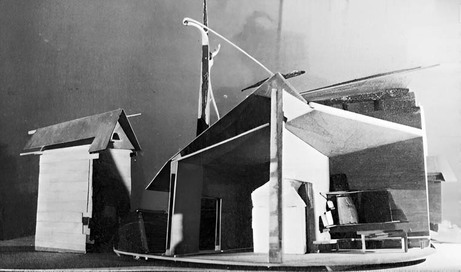
Barrie selected three case studies to illustrate his theories, the first of which was Carl Jung's tranquil, lakeside vacation house built in Bollingen just outside of Zurich, where the Swiss psychoanalyst spent the latter part of his life. For Jung, whose family included many architects, architecture was a potent symbolic vehicle for personal exploration, and a medium for connecting to something larger than himself. Jung regarded architectural construction like sculpting, viewing it as a process of revealing or uncovering preexisting patterns, elements, and ideas. He built the house in stages from 1922 to 1955, completing it six years before his death. Construction began with a simple but solid tower erected after Jung's mother passed away. Calling this tower the "maternal hearth," it provided refuge for Jung during an unstable time in his life. The house slowly expanded to a large complex of rooms and towers, and the completion of the final tower represented to Jung the achievement of psychic wholeness. This upper tower, whose interior surfaces were covered with symbolically charged paintings, was kept locked (as it still is today) and provided the most private, spiritual space for Jung. The grounds of the house are dotted with steles that Jung created to be part of the site. The images and texts Jung carved were elaborations upon inherent patterns that he recognized in the stone. Barrie argued that the stone carvings—-and, by extension, the house itself--represented Jung's way of rendering the problematic immobile, in order to achieve a sense of inner peace.

In contrast to Jung's isolated vacation home, the Sokullü Mosque is embedded in an urban context, as it was built by the Ottoman architect Mimar Sinan in the 1570s on the steep slope of a fishing port in Istanbul. Sinan's work has been overshadowed by his well-known Renaissance contemporaries and the Sokullü Mosque is also one of his more modest creations. Yet the mosque reveals Sinan's skilled technique. Because Islam prohibits the use and worship of religious images, it is through Sinan's careful proportioning and use of decoration, often in geometric forms, that the divine is symbolized and a powerful connection to God is produced. The buildings of the complex are organized around a courtyard, and include a school at the western entry and a hostel for scholars at the back of the courtyard, while a fountain at the center of courtyard is used for ritual cleansing. According to Barrie's analysis, these buildings, as well as the inner spaces of the mosque, bear a proportional relationship to one another and reveal a series of repeated dimensions based on the square and cube, typical motifs in Islamic architecture. The mosque's interior layout is unusual for Ottoman architecture: built along a sextagonal base, as opposed to the more traditional octagonal form, the unity of the interior spaces is emphasized and centered on the dome of the mosque. In counterbalance to the austere exterior of the complex, the interior of the mosque is exuberantly ornamented with tiles bearing geometric patterns in reds, greens, and blues. The colors, combined with the effects of limited direct light, creates a verdant oasis.

The final part of Barrie's presentation turned to a contemporary work, St. Benedict's Abbey at Vaals by Hans Van der Laan, to demonstrate how the idea of architecture as a sacred mediator has been carried through to modern architecture. Van der Laan, an architect turned Benedictine monk, built several extensions-—a cloister, library, and church-—to the original monastery, which is located in a hilly, unpopulated corner of southeastern Holland. In his writings, the architect-monk expressed his view of architecture as an intermediate space between earth and the heavens and referred to this liminal space as "the datum of architecture." As the sacristan, Van der Laan was responsible for calling the brothers to prayer, and the correlation between the regulated daily life of Benedictine monks and the ordered spatial relationships that characterize Van der Laan's architecture is evident. It is best manifested in Van der Laan's design methodology, which is based on a comprehensive system of careful proportioning and numerical relationships. In the abbey's church, for example, the entry, visiting rooms, atrium of the stairs, and the church itself are each proportioned to one another through a series of ratios that correspond to the Fibanacci Golden Sectional Series. The library, which Barrie studied most closely, provided Van der Laan with the opportunity to work out his proportioning even more fully: the façade's upper and lower zones are clearly delineated and are based on the geometric progression of squares whose interrelationship is based on a ratio of .75. Through this proportioning and ordering, Van der Laan felt that he had established, as he described it, an earthly connection to God.

Thomas Barrie is an Associate Professor of Architecture at Lawrence Technological University in Southfield, Michigan where he teaches design studio and courses in history-theory and design theory. He is the author of Spiritual Path, Sacred Place: Myth, Ritual, and Meaning in Architecture (Shambhala, 1996; now out of print). In 2000, Barrie received a Graham Foundation grant to support research on the mediating role of sacred architecture, which will result in a book publication.

Lecture Review by Stephanie Whitlock, Graham Foundation


Close this window