Publication
-
The Italian Piazza Transformed: Parma in the Communal AgeMarina Areli
AuthorThe Pennsylvania State University Press, 2012 -
GRANTEE
Areli MarinaGRANT YEAR
2011

Madlener House
4 West Burton Place
Chicago, Illinois 60610
Telephone: 312.787.4071
info@grahamfoundation.org
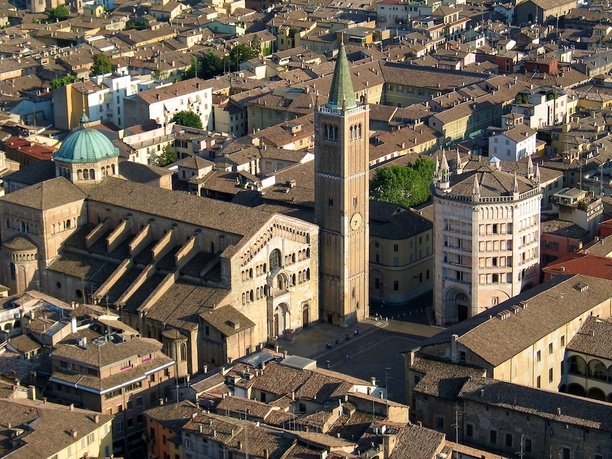
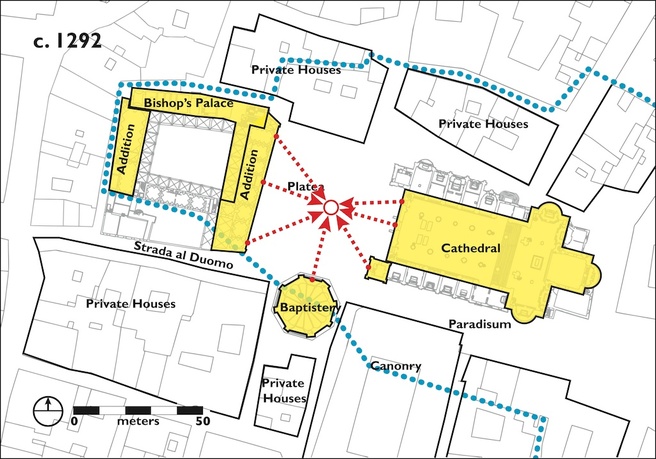
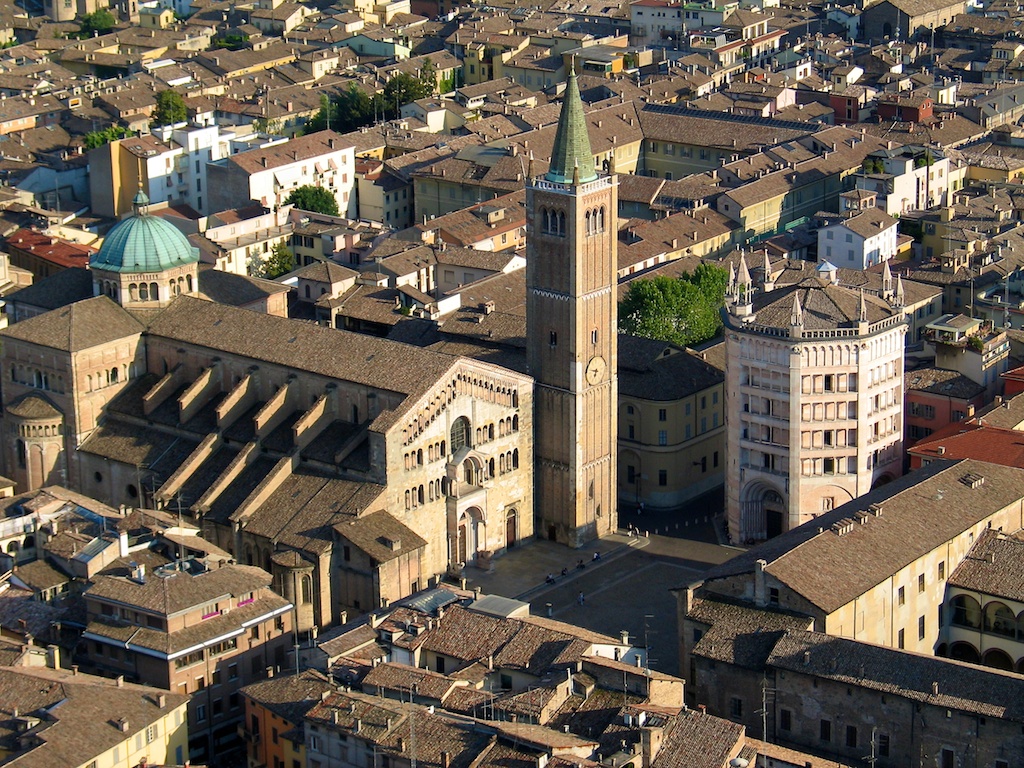
Figure 3, Aerial view of Parma's Piazza del Duomo (Cathedral Square) from the northwest, 2004. Photo: Carlo Ferrari.
This book examines the urbanistic transformation of the mid-sized city of Parma, Italy, from 1196 to 1350. Although medieval Parma is not well known in Anglophone circles, the city was at the vanguard of the political and urbanistic revolution that took place in the Lombard plain during the thirteenth century. The progressive political patrons of the plain produced the most sophisticated civic spaces in Europe by combining ancient Roman and contemporary courtly forms and practices. This study of Parma's communal and cathedral squares reconstructs the city's two most important public spaces, analyzes their form and cultural significance, and demonstrates that cities in northern Italy developed monumental civic centers long before the better-known sites in central Italian Tuscany. Intriguingly, this radical redevelopment of the city's public spaces took place not in a time of peace and prosperity, but amidst war and social unrest that characterized Italy's communal age.
Areli Marina is an art historian who teaches medieval and Renaissance architectural history at the University of Illinois, Urbana-Champaign. She received her art-historical training at Florida State University (MA, 1996) and the Institute of Fine Arts at New York University (PhD, 2004). Fellowships and grants from the American Academy in Rome and the University of Illinois supported extensive on-site research in Italy for this project. Her scholarly work focuses on the intersection of public rhetoric, identity, and civic art production, particularly in relation to the semiotics of architecture and urban form, with particular emphasis on northern Italy. Currently, she is working on two new projects, a cultural history of the Italian baptistery from 1000 to 1500 and a study of the material culture of lordship in the Mediterranean world between 1200 and 1400.
Copyright © 2008–2026 Graham Foundation. All rights reserved.