Research
-
Imaginative Beholding: Physiological Psychology and the Discourse on Representation in Fin-de-Siècle Germany
-
GRANTEE
Winifred E. NewmanGRANT YEAR
2011

Madlener House
4 West Burton Place
Chicago, Illinois 60610
Telephone: 312.787.4071
info@grahamfoundation.org
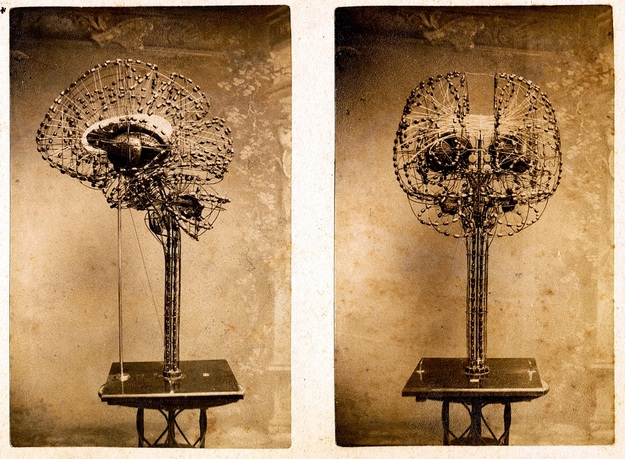


Edward B.Titchener, A phantom of the course of fibers in the human brain, 1895, Photographic Album on Psychological Instruments, USA.
From classical antiquity to the late-nineteenth century, representation in art was judged successful based on its broadly mimetic fidelity to nature. The changing sense of reality at the turn of the century brought to the fore a new paradigm of representation—seemingly as a clean rupture with the past—that celebrated abstraction, and distortion of the natural became the norm. In short, the question is: why did art become modern? Imaginative Beholding demonstrates that the modernist understanding of representation was not solely a rupture with the past but developed within a productive exchange of concepts between the arts and sciences in the latter half of the nineteenth century, including the disciplines of psychology, art history, and aesthetic philosophy. The emergence of modernism depended on the new psychologism not only to explain the effects of a work of art and the new role of the observer, but also to suggest that a revised mechanics of thought is necessary to rationalize the reality of modernism through representation.
Winifred E. Newman focuses on the philosophy of aesthetics and science, histories of science and technology, and current issues in neuroscience and architecture. She was formerly a research fellow at the Max-Planck Institute for the History of Science in Berlin. She received a PhD from Harvard University. She worked in architectural practice in Austin, Chicago, Washington DC, London, and St. Louis, and has taught at the University of Tennessee, Harvard, and Washington University in St. Louis. Winifred currently teaches at Florida International University and is a partner in Architect of Record.
Copyright © 2008–2026 Graham Foundation. All rights reserved.