
Madlener House
4 West Burton Place
Chicago, Illinois 60610
Telephone: 312.787.4071
info@grahamfoundation.org
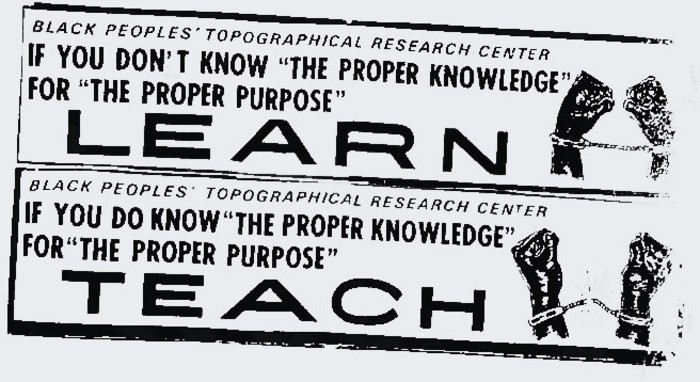
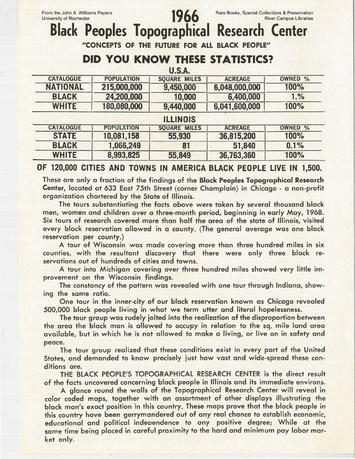
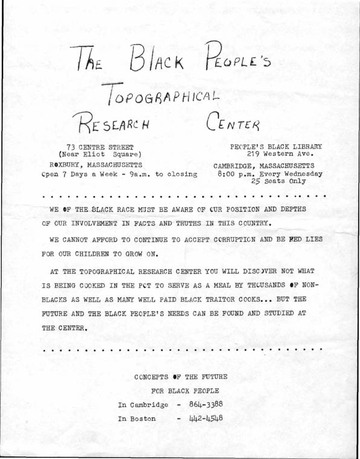
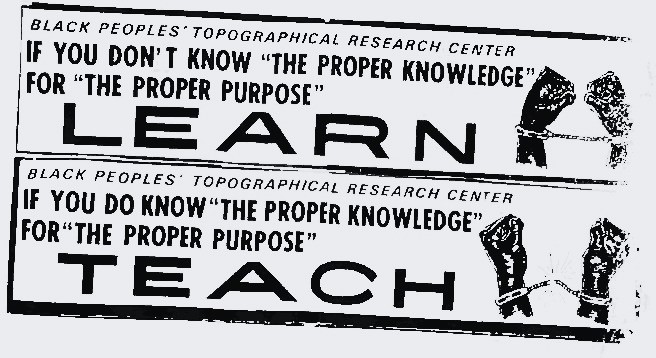
Original designer unknown, “Logo, Black Peoples’ Topographical Research Center,” undated. Digital illustration based on item held in the collection of the Harriet Tubman Museum, Macon, GA. Courtesy Sharifa Rhodes-Pitts
The Proper Knowledge / The Proper Purpose animates the dispersed, suppressed and contested histories of the Black People’s Topographical Research Center (TOP), a radical think tank that operated in cities across the United States from the late 1960s through early 1980s. In storefront venues, from Chicago to Newark, Baltimore, Pittsburgh, Boston, Hartford, Los Angeles and Kalamazoo, the TOP offered a three-hour “tour” in which statistics, maps, and migration plans designed to concentrate Black demographic power were compiled and displayed, enacting a grassroots popular education model to elucidate the origins and manipulated desolation of Black urban life, not as fact but as design. A mobile display and immersive space recreating the TOP “tour” offers a site for participatory mapping and visioning sessions, through which inhabitants of the neighborhoods where TOP operated can make their own maps and imagine alternative environments.
Sharifa Rhodes-Pitts has published widely on African-American history, politics and culture. Her book Harlem Is Nowhere (Little, Brown, 2011), was a New York Times Notable Book, a National Book Critics Circle Finalist and cited by Bookforum as the “Best New York Book” written in the twenty years since the magazine’s founding. Her book for young readers Jake Makes a World: Jacob Lawrence a Young Artist in Harlem (MoMA, 2015) was named by Booklist among the year’s top books about art for children. She is a frequent contributor to artist monographs and exhibition catalogues, including volumes on Simone Leigh, Richard Mayhew, and Dawoud Bey. The inaugural Curator-in-Residence at Weeksville Heritage Society in Brooklyn, Rhodes-Pitts is an associate professor of writing at Pratt Institute and organizes collaborative public projects through The Freedwomen’s Bureau.
Copyright © 2008–2026 Graham Foundation. All rights reserved.