Publication
-
Architecture and the National Academy of Design: An Untold HistoryJulian Rose and Gregory Wessner
EditorsNational Academy of Design, 2027 -
GRANTEE
National Academy of DesignGRANT YEAR
2026

Madlener House
4 West Burton Place
Chicago, Illinois 60610
Telephone: 312.787.4071
info@grahamfoundation.org
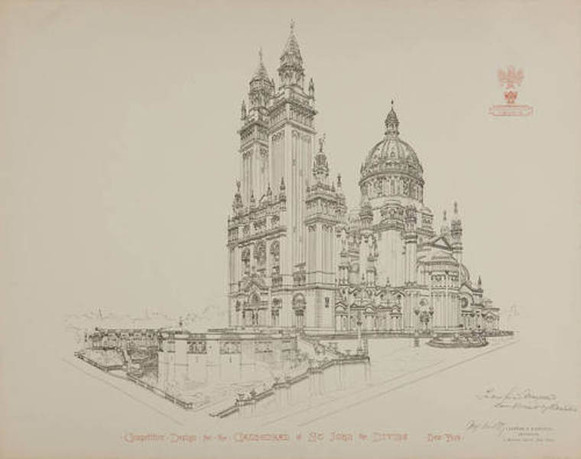




John Merven Carrère, “Competition for Cathedral of Saint John the Divine,” 1889. Photographic reproduction of pen and ink drawing, 22 x 28 in. Courtesy National Academy of Design, New York, Gift of George Maynard
Organized in conjunction with the 200th anniversary of the National Academy of Design’s founding, this project explores, for the first time, the history of architects and architecture within the nation’s oldest artist- and architect-run organization. The project probes a wealth of archival resources, beginning with the membership of Academicians—a community of more than 2,400 artists and architects elected since 1826 in recognition of their cultural achievements—as well as the Academy’s historic collection of 8,000 artworks (paintings, sculptures, architectural drawings and models, and more), donated by Academicians upon their election. The project deepens public understanding of the evolving relationship between architecture and the visual arts in America. By reinterpreting historical materials, it offers fresh perspectives on the evolution of American architecture. The findings are presented through a publication and symposium, making this research widely accessible to architects, artists, scholars, and the public.
Gregory Wessner serves as lead researcher for this project and has been executive director of the National Academy of Design since 2020. Wessner previously served as executive director of Open House New York (OHNY). Prior to OHNY, he worked at the Architectural League for nearly two decades, serving in a variety of positions, including exhibitions director. He also served as chief administrator of the National Academy of Design School of Fine Arts and White Columns. In recognition of his contributions to architecture culture in New York City, Wessner received the Award of Merit from the American Institute of Architects New York (AIANY) in 2020, the highest honor given by AIANY to a nonarchitect. Wessner conducted doctoral research in art and architectural history at the Graduate Center of the City University of New York and completed his undergraduate studies in art history at Rutgers University.
Julian Rose serves as coresearcher for this project. Rose is a historian and critic of art and architecture. From 2012 to 2018, he was a senior editor at Artforum, and he regularly contributes to a wide range of publications, including Aperture, Architectural Review, Artforum, Bookforum, Log, Perspecta, and October. His work as a cofounder of the award-winning design studio Formlessfinder has been exhibited internationally at venues including The Museum of Modern Art, the Chicago Architecture Biennial, and the Venice Biennale of Architecture. Rose received a bachelor’s degree in the history of art and architecture from Harvard University and an MArch from Princeton University, and he has taught architectural design and history at Columbia University and Princeton University. His latest book, Building Culture (Princeton Architectural Press, 2024), explores the architecture of art museums. He is completing a PhD at Princeton University on the origins and evolution of museums of contemporary art.
The National Academy of Design promotes art and architecture in America through exhibition, education, and research. Created by a small group of artists and architects in 1825 to advance art and architecture in the United States, it was the first institution in the country founded and led by professional artists and architects; it included a school to instruct aspiring artists and an annual exhibition so they could show their work to the public. The founding members also recognized excellence and achievement in the arts through the election of leading artists and architects as National Academicians. Today, the National Academy is the oldest artist- and architect-run institution in the US, with education and exhibition still at the core of its mission. It remains a vibrant, member-driven organization with 450 living Academicians representing myriad practices across the country, unified by a belief in the transformative power of art and architecture.
Copyright © 2008–2026 Graham Foundation. All rights reserved.