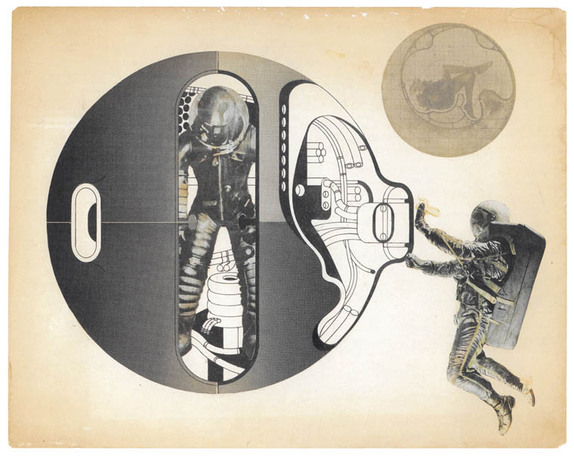
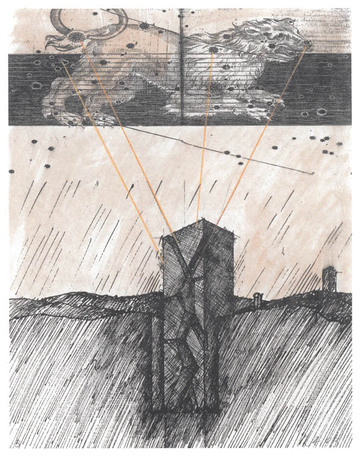
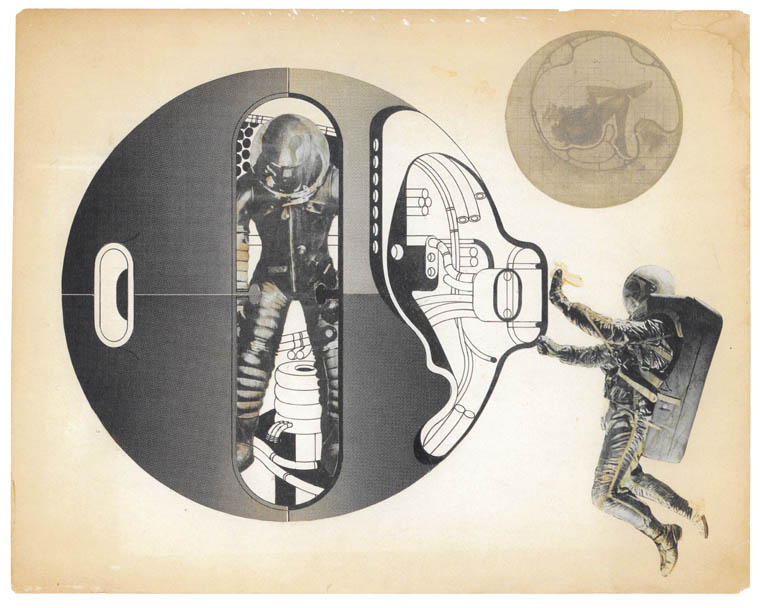
Raimund Abraham, “Living Capsule,” 1966. Collage and Indian ink, 28 x 22 in. Courtesy Una Abraham
Raimund Abraham: Earthquake of Silence surveys six decades of architectural production, tracing the development of Abraham’s work from speculative urban proposals and experimental studies of domestic space to major built projects in Europe and the United States. Featuring drawings, models, photographs, notebooks, correspondence, and literary texts, the exhibition offers a comprehensive view of his architectural imagination and its enduring influence on contemporary design culture.
Raimund Abraham (1933–2010) was an Austrian-born architect, educator, and theorist whose work bridged architectural practice, drawing, writing, and teaching. After studying at the Graz University of Technology, he moved to the United States in 1964 and later taught for decades at Cooper Union, where he influenced generations of architects. His best-known works include the Austrian Cultural Forum in New York and the House for Musicians at Insel Hombroich near Düsseldorf, Germany.
Hubertus Adam is an architectural historian, critic, and curator. After studying art history, philosophy, and archaeology, he worked as an editor for Bauwelt in Berlin and archithese in Zurich, and as a freelancer for the leading Swiss daily newspaper, the Neue Zürcher Zeitung. From 2010–15, he was director of the S AM Swiss Architecture Museum in Basel. As director he curated exhibitions on postwar architecture, including shows on Richard Neutra in Europe in the 1960s; the young state of Israel; the media of architectural communication (photography, text, film); and contemporary design practices, including the work of Bernard Tschumi. In 2024, he curated Building Worlds. Visionary Architecture in the 20th Century for the Archive of the Avant-Garde / Dresden State Art Collections, followed by Raimund Abraham: Earthquake of Silence for Museum Insel Hombroich in 2025. He is currently chief editor of archithese.
Steven Hillyer is the director of The Irwin S. Chanin School of Architecture Archive. During his 35-year career at The Cooper Union he has assisted and led the curation, design, and installation of dozens of exhibitions at Cooper and abroad. Hillyer has presented the work of distinguished architects such as Raimund Abraham, John Hejduk, Louis I. Kahn, Josef Kleihues, Daniel Libeskind, Carlo Scarpa, Michael Webb, and Lebbeus Woods—often working directly with them. His international work includes exhibitions at Prague Castle, the Netherlands Architecture Institute, and the Canadian Centre for Architecture. Hillyer's exhibitions have also featured artists Mary Kelly, Costantino Nivola, Robert Slutzky, and Torkwase Dyson, and photographers J. Henry Fair and Margaret Morton. For this exhibition, Hillyer collaborates with curator Hubertus Adam to shape its content for presentation in the school’s Arthur A. Houghton Jr. Gallery. He received his bachelor’s in architecture from The Cooper Union.
Chris Dierks, the archive’s associate director, helps coordinate the exhibition’s development and installation. He is instrumental in fundraising for the archive’s exhibitions, publications, and digital collections. Dierks previously worked as the archivist for Acconci Studio, a Brooklyn-based architecture and design office, and as the archive manager for Van Alen Institute’s Design Archive. He has consulted for several New York based nonprofit design organizations and received a BA in architecture from Princeton University.
Founded by inventor, industrialist, and philanthropist Peter Cooper in 1859, The Cooper Union for the Advancement of Science and Art offers education in art, architecture, and engineering, as well as courses in the humanities and social sciences. The Cooper Union is dedicated to Peter Cooper’s radical commitment to diversity and his founding vision that fair access to an inspiring free education and forums for courageous public discourse foster a just and thriving world. Our mission is to sustain The Cooper Union as a free center of learning and civic discourse that inspires inventive, creative, and influential voices in architecture, art, and engineering to address the critical challenges and opportunities of our time.