-
upcoming events
Josephine’s Sharmyn Cruz Rivera and Daniel Giles Oct 16, 2026 Talk
David Behrman & Cleek Schrey Lampo Performance Series Nov 07, 2026 Performance
FORCE! an opera in three acts Anna Martine Whitehead Nov 12, 2026 Book Launch
Henry Fraser Lampo Performance Series Dec 05, 2026 Performance
-
past events

Madlener House
4 West Burton Place
Chicago, Illinois 60610
Telephone: 312.787.4071
info@grahamfoundation.org
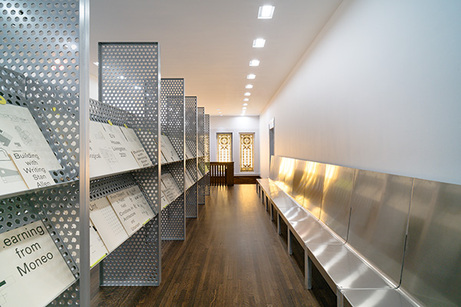
Gallery and Bookshop Hours
Chicago Architecture Biennial
Jan 01, 2026 - Feb 28, 2026
(12pm)
CURRENT EXHIBITION
Fragmented Manifestos
SHIFT: Architecture in Times of Radical Change
Chicago Architecture Biennial
Curated by Florencia Rodriguez
Through Feb 28, 2026
GALLERY AND BOOKSHOP HOURS
Wednesday–Saturday, 12–5 p.m.
Free admission, no reservations required—ring the doorbell for entry.
Fragmented Manifestos brings together a constellation of moments in recent architectural history that emerged in response to periods of radical transformation—political, technological, and cultural. Participants include: Amancio Williams, Sergio Prego, Anne Tyng, Diller Scofidio + Renfro, Charles Jencks, Stan Allen, and a collaboration between MOS and Tony Cokes. Hard Sun Interstate by Sam Chermayeff Office was hosted by the Graham Foundation during the Biennial’s opening weekend (September 18–20, 2025).

Zosha Warpeha
Lampo Performance Series
Feb 21, 2026
(7pm)
RSVP required, limited capacity (SOLD OUT)
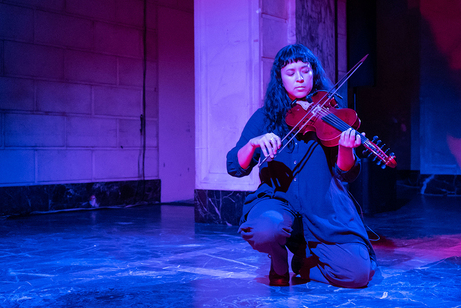
In dilations, Zosha Warpeha treats body, instrument, and room as a single resonant system. She performs on the hardanger d’amore, a fiddle with additional sympathetic strings that enrich its sound. Here, moving slowly among the audience, she settles into distinct positions for each musical movement, so that changes in proximity and angle affect what each listener hears.
Her new performance is fully acoustic, exploring scale, stillness, and suspension, using repetition to reveal how much information lives inside simple, sustained tones.
Zosha Warpeha (b.1994, Milaca, Minn.) is a Brooklyn-based composer-performer working at the intersection of contemporary improvisation and folk traditions. Her long-form compositions explore transformations of time, tonality, and resonant space. She performs primarily on the hardanger d’amore, a sympathetic-stringed instrument closely related to the Norwegian Hardanger fiddle. While her work draws on the cyclical forms and physical momentum of Nordic folk music, her solo practice treats tradition as a material to be reworked rather than preserved.
She has performed at Issue Project Room, Brooklyn; Emanuel Vigeland Museum, Oslo; Frequency Festival, Chicago; Newport Jazz Festival, Newport, RI; Vesterheim Museum, Decorah, IA; The Stone, New York; Detroit Institute of Arts, Detroit; Greenwood Cemetery Catacombs, Brooklyn; and Duluth-stämman Nordic Music Festival, Duluth, MN, among others. Collaborators include Bill Frisell, Eyvind Kang, Shahzad Ismaily, Henry Birdsey, Leila Bordreuil, Elori Saxl, Kaïa Kater, Anne Hytta, and Unni Løvlid. Ongoing projects include duos with percussionist Carlo Costa, bassist Tristan Kasten-Krause, and instrument builder Webb Crawford, as well as a string trio with Biliana Voutchkova and Isidora Edwards.
Recordings include silver dawn (Relative Pitch Records, 2024); Orbweaver (Outside Time, 2025), a duo collaboration with Mariel Terán; and I grow accustomed to the dark (Outside Time), to be released in March 2026.
Warpeha has been an artist in residence at Issue Project Room and the Anderson Center, Red Wing, MN, and her work has been supported by the U.S.-Norway Fulbright Foundation, the Jerome Foundation, and the Minnesota Arts and Cultural Heritage Fund. She holds degrees in Nordic folk music and jazz and contemporary music from the Norwegian Academy of Music in Oslo and The New School in New York.
Lampo, established in 1997, supports artists working in new music, experimental sound, and other interdisciplinary practices. The Chicago-based organization's core activity has been and remains its performance series. Rather than making programming decisions around tour schedules, Lampo invites selected artists to create and perform new work, and then the organization provides the space, resources, and curatorial support to help them fulfill their vision. Lampo also organizes artist talks, lectures, screenings, and workshops, and publishes written and recorded documents related to its series.
Accessibility: This event will be held in the ballroom on the third floor of the Madlener House, which is only accessible by stairs. The first-floor galleries and bookshop are accessible via outdoor lift. Please contact us at 312.787.4071 or info@grahamfoundation.org to make arrangements.
Note: Registration for Lampo programs is required, but does not guarantee entry. Capacity for this performance is limited. Doors open 30 minutes prior to the performance and seats are available on a first-come, first-serve basis for those registered in advance. Reservations expire 5 minutes before the performance start time, at which point seating will be released to the waitlist. Due to the popularity of the Lampo programs, performances quickly reach capacity. No late seating will be permitted.
Photo: Cameron Kelly McCleod
Bookshop Sale
Feb 21, 2026 - Feb 28, 2026
(12pm)
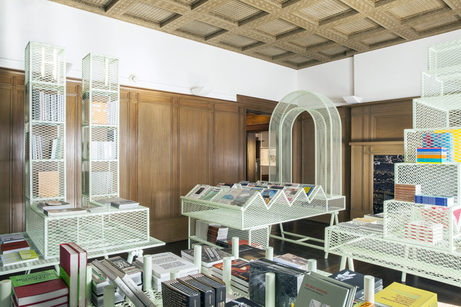
As Fragmented Manifestos enters its final week, the Graham Foundation Bookshop is offering 20% off all purchases from Saturday, February 21, through Friday, February 28, plus a Chicago Architecture Biennial tote bag with purchases over $100.
The Graham Foundation Bookshop features a curated selection of publications by Foundation grantees, alongside new, historically significant, and rare books on architecture, art, urbanism, and related fields. In addition to monographs, exhibition catalogues, and theory-based titles, the bookshop carries local and international journals and magazines. Chicago-based designer Ania Jaworska designed the bookshop in 2013.
Sale Hours:
Sat, Feb 21 — 12–8 p.m.
Wed, Feb 25 — 12–5 p.m.
Thu, Feb 26 — 12–5 p.m.
Fri, Feb 27 — 12–5 p.m.
Sat, Feb 28 — 12–5 p.m.
On view in the galleries: Fragmented Manifestos, part of the sixth edition of the Chicago Architecture Biennial, SHIFT: Architecture in Times of Radical Change, an exhibition bringing together episodes from recent architectural history through drawings, writings, diagrams, installations, and proposals by Amancio Williams, Sergio Prego, Anne Tyng, Diller Scofidio + Renfro, Charles Jencks, Stan Allen, and a collaboration between MOS and Tony Cokes.
Sale discount cannot be combined with student/educator discounts; discount not valid on select items.
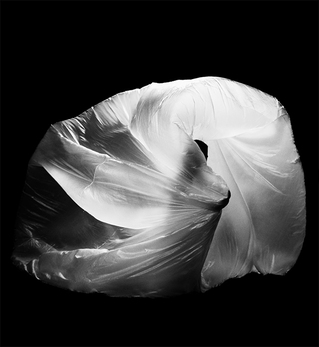
Photo: Ricardo E Adame
Chicago-based artist Irene Hsiao presents 氣, a piece developed for performances across the Chicago Architecture Biennial and part of Hsiao's project Mond(e): 月亮代表我的心, named for the Taiwanese love song "The moon represents my heart." In 氣, Hsiao performs in response to a sculpture by artist and fellow Biennial participant Dominic Kießling, accompanied by soprano Mickey Farès. Inspired by the shifting phases of the moon and the impermanence of architecture and anatomy, the work explores the interplay of air and energy—氣 (qi)—as Kießling’s sculpture receives, amplifies, and returns each movement and emotion in a cycle of mutual transformation. Mond(e): 月亮代表我的心 – 氣 was developed at the Graham Foundation in fall 2025 for presentations at the Narrow Bridge Arts Club and the Driehaus Museum and Hsiao returns to the Madlener House for the closing presentation.
Mond(e): 月亮代表我的心 is a year-long performance and community art project developed through Hsiao's 2025 residency at Hyde Park Art Center, creating site-specific performances with new collaborators that evolve in reference to the moon's periodic phases and its influence. This program is partially supported by an Individual Artists Program Grant from the City of Chicago Department of Cultural Affairs and Special Events, as well as a grant from the Illinois Arts Council, a state agency, from federal funds through the National Endowment for the Arts.
Irene Hsiao creates dance and performance through object-driven inquiry with museum spaces, exhibitions, and artworks. She is the inaugural Artist in Residence at the Smart Museum, first Artist in Residence at 21c Museum Hotel Chicago, first Resident Artist at the Heritage Museum of Asian Art, a Radicle Resident at Hyde Park Art Center, and the first artist in residence at the Chinese Fine Arts Society.
Dominic Kießling is a visual artist whose practice transforms lightweight materials into large-scale kinetic installations animated by fans, hair dryers, or human performance. Born in Dresden in 1984, he studied industrial design before working for a decade in motion and stage design in Berlin. In 2019, he returned to Dresden to focus on analogue art, experimenting with everyday materials and immersive sculptural forms. In 2023, he established his studio in a former factory building to pursue one of his most ambitious projects. Starting with little more than plastic bags and a hair dryer, Kießling developed a dynamic aesthetic that blurs the line between object and organism. His work continues to explore themes of transformation, movement, and material tension.
Mickey Farès is a Chicago-based soprano and improviser with a rich cultural heritage rooted in Venezuela, Spain, and Lebanon. Trained in classical opera performance, her vocal practice explores the full elasticity of the human voice—stretching its expressive limits and weaving together a diverse range of sonic textures. Her improvisational style draws on the raw spontaneity of free jazz and the rich emotionality of Spanish folkloric singing, creating a unique and deeply embodied sound language. Collaborating with movement artists has become central to her work, where the interplay of physical and vocal expression allows for a dynamic exchange of energy between performers. At the heart of her artistic process is a commitment to shared energy—how it is passed, shaped, and amplified among collaborators. For Mickey, improvisation is a playground for presence, curiosity, and connection.
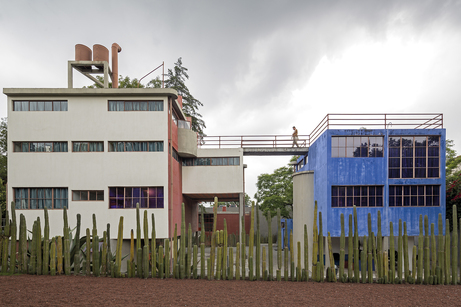
Brazilian photographer and visual artist Leonardo Finotti discusses Latinitudes and his long-term project documenting modern architecture across Latin America, including the development of the exhibition and its accompanying publication series with Lars Müller Publishers. The talk is followed by a reception to celebrate the opening of the exhibition.
Latinitudes, presented for the first time in the United States, is a photographic survey of modern architecture across twelve Latin American cities: Buenos Aires, Argentina; Bogotá, Colombia; Caracas, Venezuela; Guatemala City, Guatemala; Havana, Cuba; Lima, Peru; Mexico City, Mexico; Montevideo, Uruguay; Quito, Ecuador; San José, Costa Rica; Santiago, Chile; and São Paulo, Brazil. Featuring more than 100 photographs by Finotti and curated by Brazilian architect Michelle Jean de Castro, the exhibition presents modern architecture across Latin America from a new perspective. Combining the words "latitudes" and "Latin," the exhibition proposes a horizontal framework connecting cities across shared geographies and histories, presenting housing, civic, and cultural works by key figures of modernism—Luis Barragán, Lina Bo Bardi, Roberto Burle Marx, Félix Candela, Eladio Dieste, Emilio Duhart, Ricardo Legorreta, Paulo Mendes da Rocha, Oscar Niemeyer, Juan O'Gorman, Mario Pani, Ricardo Porro, Rogelio Salmona, Clorindo Testa, and Carlos Raúl Villanueva, among others.
Leonardo Finotti is a visual artist based in São Paulo, Brazil, whose work centers on two complementary themes: modern architecture and anonymous or informal urban spaces. Trained as an architect, he holds a bachelor of arts in architecture from the Universidade Federal de Uberlândia; completed postgraduate studies at the Bauhaus Foundation in Dessau, Germany; and began his career in Portugal before returning to Brazil to embark on a long-term photographic project that revisits and reinterprets the legacy of modern architecture across Latin America and beyond. Alongside collaborations with international architects, institutions, and publications, Finotti has produced a number of independent projects through exhibitions and books, including Pelada (2014); Latinitudes (2015); Rio Enquadrado (2016); A Collection of Latin American Modern Architecture (Lars Müller, 2016); and Sacred Groves & Secret Parks (2019). His work has been widely exhibited and is held in the collections of The Museum of Modern Art (MoMA), New York; Bündner Kunstmuseum Chur (Switzerland); Fundação EDP (Portugal); Architekturzentrum Wien (Austria); Bauhaus Dessau Foundation (Germany); and Museu Brasileiro da Escultura e Ecologia (Brazil), among others. He has represented Brazil at two International Architecture Exhibitions, La Biennale di Venezia; the 10th Mercosul Art Biennial, Porto Alegre, Brazil; and was a prizewinner at the 15th Buenos Aires International Biennial of Architecture.
For more information on the exhibition, Latinitudes
A Collection of Latin American Modern Architecture, click here.
Italian Journeys
Andrea Bagnato in conversation with Jennifer Scappettone
Apr 07, 2026
(6pm)
Talk
Free; RSVP required
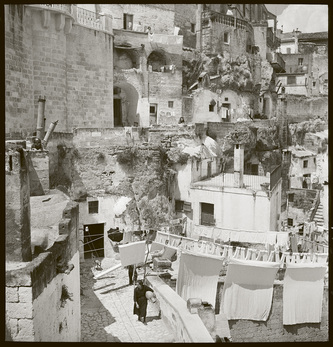
In Terra Infecta, Andrea Bagnato traces a political ecology of the Italian landscape. The book, recently published by MACK, uses the lens of health and illness to explore how the modern quest for sanitation shaped Italy's urban and rural landscapes through architecture, demolition, and displacement. The result of a decade of research and fieldwork supported in part by a grant from the Graham Foundation, Terra Infecta recounts histories of dispossession and resistance in Naples, Venice, Milan, and Matera.
Andrea Bagnato is joined by Jennifer Scappettone for a reading and conversation. Drawing from their respective research and writing, Bagnato and Scappettone discuss the long-term markings that fascism, internal colonialism, and modernization have left on the physical environment, and how different narrative forms can help us make sense of ecological change.
Andrea Bagnato is an architect and writer based in Genoa, Italy. He has taught at Piet Zwart Institute, Rotterdam; the Architectural Association School of Architecture (AA), London; and the Decolonizing Architecture program at the Royal Institute of Art, Stockholm. Previous books include the collective volumes Rights of Future Generations (Hatje Cantz, 2022) and the Graham-funded A Moving Border: Alpine Cartographies of Climate Change (Columbia, 2019).
Jennifer Scappettone works at the confluence of the literary, visual, and scholarly arts, and is professor of literature and faculty affiliate of the Committee on Environment, Geography, and Urbanization at the University of Chicago, where she directs the Environmental Arts+Humanities Lab. She is the author of five full-length books of poetry, translations and prose, including most recently Poetry After Barbarism, The Republic of Exit 43, and Killing the Moonlight: Modernism in Venice.
Presented with support from the Istituto Italiano di Cultura di Chicago.
Image: Marjory Collins, Life in Matera before the evictions, 1950. Photograph. Courtesy Schlesinger Library, Harvard Radcliffe Institute, Cambridge, MA
Friday, April 10, 12–8 p.m.
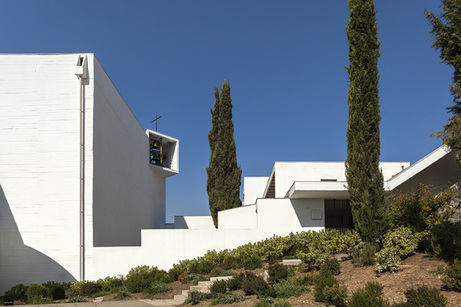
As part of EXPO ART WEEK, the Graham Foundation galleries and bookshop will be open late on Friday, April 10, with extended hours until 8 p.m. to explore Latinitudes: A Collection of Latin American Modern Architecture, with photographs by Leonardo Finotti and curated by Michelle Jean de Castro.
Click here to explore the EXPO ART WEEK guide and discover galleries and institutions participating across the city.
Kari Watson — SOLD OUT
Lampo Performance Series
Apr 18, 2026
(7pm)
Performance
Limited capacity — SOLD OUT
This event is sold out. Due to limited capacity, no additional tickets are available. We appreciate your interest and hope to see you at a future event.
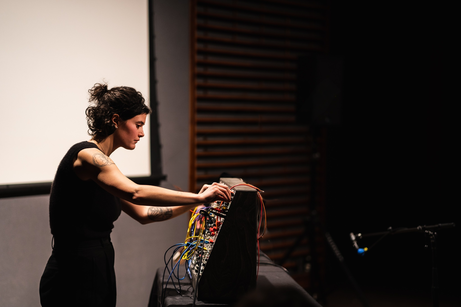
Kari Watson premieres Fuse, a new solo performance for analog modular synthesizers and programmed drum machines. The piece plays with clock function and tempo ramps, moving between analog and digital environments as Watson shapes the sound in real time.
Fuse engages a quadraphonic speaker array in tandem with a spatial audio sculpture of unhoused speaker cones distributed through the room. A custom synth garment—made in collaboration with visual artist and designer Av Grannan—houses patch cables and an XLR snake that tie Watson’s body into the setup. Modular instruments sit atop custom ceramic tables made with visual artist and ceramicist Paige Schlosser, designed so cables can be woven in and around the surfaces.
Watson takes theorist Donna Haraway’s cyborg as an origin point for the project: a figure of synthesis and hybridity, where humans and machines are enmeshed and the boundaries between body and environment are continually unsettled. Fuse makes that unsettled boundary audible, asking where the performer ends and the surrounding system begins.
Kari Watson (b.1998, Philadelphia, Pa.) is a composer, performer, and intermedia artist working across contemporary concert music, electroacoustic composition, live performance, and installation. As a performer on analog synthesizers, Watson integrates custom spatialization systems built in Max/MSP with multi-speaker arrays, foregrounding tactility and drama in spatial sound.
Watson’s work has been presented at Darmstädter Ferienkurse, Darmstadt; Donaueschinger Musiktage, Donaueschingen; MINU Festival for Expanded Music, Copenhagen; Les Écoles d’Art Américaines de Fontainebleau, Fontainebleau; the Composers Now Dialogues Series; Ravinia Festival’s Breaking Barriers Festival; and Frequency Festival, Chicago, among others. Additional presentations have taken place at KM28 and Richten25, Berlin; The Horse Hospital and IKLECTIK Art Lab, London; Werkstatt für Improvisierte Musik Zürich; Khimaira, Stockholm; the Chicago Cultural Center; and the International Museum of Surgical Science.
Collaborators include Jennifer Torrence, Maya Bennardo, Sarah Saviet, Yarn/Wire, Collective Lovemusic, Eduard Teregulov, Ensemble Dal Niente, TAK Ensemble, MIVOS Quartet, Line Upon Line, and Quatuor Diotima. Recent projects have also been presented through Roulette; Experimental Sound Studio; and International Anthem’s 11×11 Series with Katinka Kleijn.
Recordings include enclosures (Sawyer Editions, 2025) and VISTAS, with Katinka Kleijn (Elektramusic, 2025). Watson received the 2023 Kranichstein Music Prize for Composition from the Darmstädter Ferienkurse and a 2022 Charles Ives Scholarship from the American Academy of Arts and Letters. Watson is currently a Ph.D. candidate in music at the University of Chicago.
Photo: Eduard Teregulov
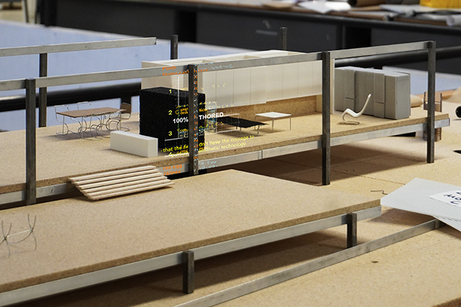
Architecture of Noise
Nile Greenberg, 2025–26 Douglas A. Garofalo Fellow
Apr 23, 2026
(6pm)
Talk
Free; RSVP required
Nile Greenberg presents Architecture of Noise, his research as the 2025–26 Douglas A. Garofalo Fellow at the University of Illinois Chicago (UIC) School of Architecture. Greenberg asserts that the present is a battery—that we preside over a time of noise, not signal and noise, not the noise of the past, but a gesamtkunstwerk of noise: every inch authored by someone.
Through projects and research developed at UIC, he examines how architecture can operate within overlapping crises—environmental, economic, and political—where control is often dispersed across many actors and systems. Architecture must author and reauthor its contexts and sites, remake the present, and confront its responsibilities and its risks. Greenberg positions this as a call for architecture to recalibrate itself within crisis, within noise, and within its history.
This talk follows the exhibition of Architecture of Noise at the Edith Farnsworth House (April 19–20), which brings together a series of projects: a film; a reimagined history of Chicago; a survey of sites shaped by environmental and economic forces; a visual survey of Chicago architecture; and a new masterplan for the Farnsworth House. Part of the exhibition, including Illuminated Archive and the film 100% Authored, will be on view in the Graham Foundation's third-floor gallery in conjunction with the talk.
Related Exhibition:
The Edith Farnsworth House, 14520 River Rd, Plano, IL 60545
Free admission. No registration required. Check in at the visitors center.
Opening: Sunday, April 19, 4–6 p.m.
Open House: Monday, April 20, 2–6 p.m.
Free admission. No registration required. Check in at the visitors center.
Opening: Sunday, April 19, 4–6 p.m.
Open House: Monday, April 20, 2–6 p.m.
Nile Greenberg is a founding partner of Abel Nile New York. Abel Nile New York guest edited the 2025 issue of Flash Art Volumes on the theme of Crisis Formalism—a dossier of architectural responses to re-integrate architectural form and crisis. Greenberg serves as architecture editor at The Brooklyn Rail, overseeing a section that focuses on the relationship between architecture and art. His published works include coauthoring The Advanced School of Collective Feeling (Park Books, 2023), a study on the relationship between physical culture and housing in the 1920 and curating the exhibition Two Sides of the Border at Yale. Greenberg is the 2025-26 Douglas A. Garofalo Fellow at University of Illinois Chicago. He has taught at University of Illinois Chicago; Columbia University Graduate School of Architecture, Planning and Preservation (GSAPP); and Cornell University College of Architecture, Art, and Planning (AAP). His work has been presented at the 19th International Architecture Exhibition. La Biennale di Venezia, Venice; Midway Contemporary Art, Minneapolis; ETH Zürich, Zurich; Spazio Maiocchi, Milan; Center for Architecture, New York; Rice University, Houston; Harvard University Graduate School of Design, Cambridge; University of Melbourne, Melbourne; and The Cooper Union, New York Greenberg was recognized as New Practices New York 2020-23 by American Institute of Architects, New York (AIANY).
About the Douglas A. Garofalo Fellowship
Named in honor of architect and educator Doug Garofalo (1958–2011), this nine-month teaching fellowship provides emerging designers the opportunity to teach studio and seminar courses in the undergraduate and graduate programs and conduct independent design research. The fellowship also includes a public lecture at the Graham Foundation and an exhibition at the University of Illinois at Chicago (UIC) School of Architecture. To learn more about the fellowship, click here.
Note: This event will be held in the ballroom on the third floor of the Madlener House, which is only accessible by stairs. The first-floor galleries and bookshop are accessible via outdoor lift. Please contact us at 312.787.4071 or info@grahamfoundation.org to make arrangements.
Image: Architecture of Noise (model), 2026. Photo: Nile Greenberg
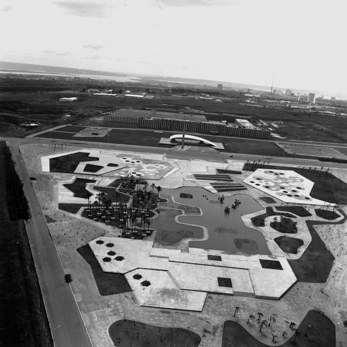
MILITARY GARDENS: Roberto Burle Marx in Brasília
Catherine Seavitt
Apr 30, 2026
(6pm)
Talk
Free; RSVP required
In this lecture, Catherine Seavitt explores two often overlooked episodes in the career of Roberto Burle Marx (1909–94): his absence from the original planning of Brasília in 1960 and his later association with Brazil’s military dictatorship through service on the Conselho Federal de Cultura. Seavitt argues that any discussion of Burle Marx and Brasília must take these histories into account. She considers, in particular, his later work for the military government in Brasília, including two ministry palace gardens and Praça dos Cristais, the large triangular plaza at army headquarters created with architect Oscar Niemeyer. Commissioned in 1967 as a military parade ground and inaugurated in 1973, Praça dos Cristais reveals the political context in which Burle Marx’s late work in the capital took shape.
The talk draws on Seavitt's book Depositions: Roberto Burle Marx and Public Landscapes under Dictatorship (University of Texas Press, 2023), supported by a grant from the Graham Foundation, and is presented in conjunction with Latinitudes: A Collection of Latin American Modern Architecture.
Catherine Seavitt is Meyerson Professor and Chair of the Department of Landscape Architecture at the University of Pennsylvania’s Stuart Weitzman School of Design. She is the faculty codirector of the McHarg Center for Urbanism and Ecology and creative director of the department’s LA+ Journal. A registered architect and landscape architect, she is a fellow of the American Society of Landscape Architects, the American Institute of Architects, the Council of Educators in Landscape Architecture, and the American Academy in Rome. Her research explores urban landscapes, post-industrial sites, toxicity, and inventive plant knowledge, with a focus on actionable responses to the climate crisis and decarbonization. Seavitt’s books include Depositions: Roberto Burle Marx and Public Landscapes under Dictatorship (University of Texas Press, 2023); Structures of Coastal Resilience, with Guy Nordenson and Julia Chapman (Island Press, 2018); and Four Corridors, with Guy Nordenson and Paul Lewis (Hatje Cantz, 2019).
Image: Roberto Burle Marx, aerial view of the Crystal Plaza garden for the Ministry of the Army with Oscar Niemeyer's Army Headquarters complex seen beyond, 1972, Brasília, Brazil. Courtesy of the Arquivo Público do Distrito Federal.
For more information on the exhibition, Latinitudes
A Collection of Latin American Modern Architecture, click here.
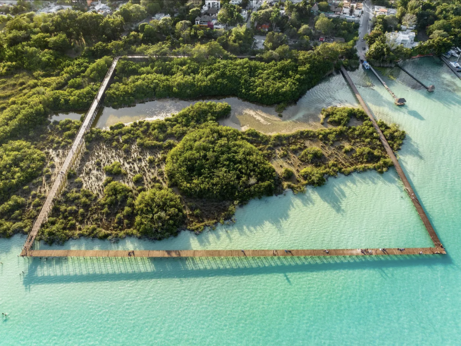
Bacalar Eco-Park Ⓒ Colectivo C733
The World Around Summit 2026
WATCH PARTY
May 09, 2026
(10am)
SATURDAY, MAY 9, 10 AM–5 PM CDT
CLICK HERE to register to attend the in-person live-stream watch party in Chicago at the Graham Foundation
CLICK HERE to buy tickets to attend in-person in New York at The Museum of Modern Art
CLICK HERE to register to live-stream the event
Join us at the Graham Foundation to watch the livestream of The World Around Summit 2026, taking place live at The Museum of Modern Art in New York. Co-curated by Beatrice Galilee and Martino Stierli, this all-day program convenes leading voices from architecture, design, and related fields to survey a year of architecture and design in a single day. Speakers present contemporary buildings alongside new projects and initiatives in landscape, climate intelligence, and design, with a focus on social and ecological justice. The 2026 World Around Summit is co-presented with The Museum of Modern Art.
An international and interdisciplinary lineup explores landscape and urbanism, material innovation, equitable futures, housing, museums, and community through The World Around’s signature format of short presentations. As part of the nonprofit’s mission to make its programming accessible to all, the summit is livestreamed globally.
Session One (10 a.m.–12 p.m. CDT): Seeding Time presents practitioners renegotiating the relationship between the built environment and the natural world, working at scales from the seed to the city. Featuring Gabriela Carrillo, Piet Oudolf, Trần Thị Ngụ Ngôn and Nguyễn Hải Long, Peggy Weil, Sara Zewde, and Mohamed Salem Mohamed Ali.
Session Two (1:30–3:30 p.m. CDT): Keeping Time explores what is protected and what recedes into the past — from questions of restitution to community, heritage, and public space. Featuring Mariam Issoufou, Marie Combette, Daniel Moreno Flores, Søren Pihlmann, Róisín Heneghan, François-Xavier Gbré, and Bas Smets.
Session Three (4–5 p.m. CDT): High Time is a civic forum on housing as architecture's most tested claim to social purpose—and what a genuinely livable city might take to build. Featuring Michael Kimmelman, Alejandro Aravena, and Tatiana Bilbao.
Founded in 2020, The World Around (TWA) is a global nonprofit platform headquartered in New York, with a simple but ambitious mission: to rethink architecture. Taking the most critical issue of our time—the climate crisis—as the lens to view all of their activities, TWA connects with global institutions to craft unique public conversations that look beyond buildings to investigate the often-invisible forces that shape our homes, cities, landscapes, and lives. The World Around Summit 2026 is co-presented with The Museum of Modern Art. The World Around Summit 2026 is supported by a grant from the Graham Foundation.
PARTICIPANTS:
Alejandro Aravena is partner and executive director of Elemental, a socially motivated architecture practice based in Santiago, Chile.
Tatiana Bilbao founded her eponymous studio in 2004 with the aim of integrating research, community-based design, and responsible construction.
Gabriela Carrillo started her eponymous studio in 2019, as a collaborative and interdisciplinary space for architectural work.
Marie Combette is an architect and founding partner of La Cabina de la Curiosidad, a Quito-based design and research practice.
François-Xavier Gbré is a photographer who lives and works between La Rochelle, France, and Abidjan, Ivory Coast.
Róisín Heneghan is co-founder of heneghan peng architects, a landscape, urban planning, and architecture practice with offices in Dublin and Berlin.
Mariam Issoufou is the founder and principal of architecture and research practice, Mariam Issoufou Architects.
Michael Kimmelman is the architecture critic for The New York Times and the founder and editor at large of Headway.
Mohamed Salem Mohamed Ali is a Sahrawi farmer, artist, and environmental practitioner who connects caring for the land, creativity, and helping his community stay strong.
Daniel Moreno Flores is an architect and founding partner of La Cabina de la Curiosidad, a Quito-based design and research practice.
Trần Thị Ngụ Ngôn and Nguyễn Hải Long are the co-founders of Tropical Space, an architecture studio based in Ho Chi Minh City, Vietnam.
Piet Oudolf is a Dutch garden designer, nurseryman, and author, renowned for his distinct approach to planting.
Søren Pihlmann is the founder of Copenhagen-based pihlmann architects.
Bas Smets is a landscape architect with a background in civil engineering and architecture.
Peggy Weil is an artist and designer whose practice spans large-scale public art installations, videos, and interactive works.
Sara Zewde is the founding principal of Studio Zewde, a landscape design, urban design, and public art practice based in New York City.
To learn more about the 2026 Summit and browse past presentations, click here.
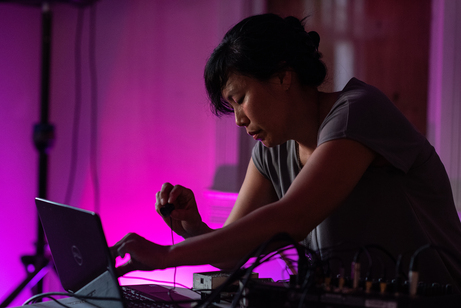
Bonnie Han Jones has created a work inspired by the tradition of Korean pansori—a musical genre incorporating song, story, and gesture—and the sonic ritual practices of female Korean shamans (mudang).
a place where many people gather (soundings) is a quadraphonic performance that considers how sound, heard in shared listening spaces, transforms listeners' relationships to history, to each other, and to place. Jones draws on archival recordings and works with circuit-bent instruments, transducers, inductors, metal, glass, and voice.
Pansori is a compound of the Korean words pan 판 and sori 소리, the latter meaning "sound." Pan is thought to refer either to a song with many tones or to a situation where many people gather, reflecting the format of the pansori performance, which usually lasted three to eight hours and took place in public, communal spaces. The pansori singer is an oral historian, carrying the past into the present.
Bonnie Han Jones (b. 1977) is a Korean American improvising musician, poet, and educator working primarily with electronic sound and text. Her work is iterative and multidisciplinary, and typically involves building concepts through research and study and then moving these ideas through a variety of mediums, methods, and forms. She uses electronic music, recorded sound materials, text, video, performance, and score, with attention to listening and improvisation as a core theme and generative method. The work broadly explores noise, sonic identity, listening as thinking, and sound as knowledge.
Jones performs both solo and in a wide range of collaborative music, film, and visual art projects. She was a founding member of the Transmodern Festival and CHELA Gallery and has been a board member of the High Zero Festival collective. In 2010, she cofounded TECHNE with Suzanne Thorpe, an organization that develops anti-racist, feminist workshops focused on technology-based artmaking, improvisation, and community collaboration.
Jones has received commissions from the ICA, London, and the Walters Art Museum, Baltimore, and has presented her work throughout the United States, Mexico, Europe, and Asia. She was a 2018 recipient of the Foundation for Contemporary Arts Grants to Artists Award. Born in South Korea, Jones was raised on a dairy farm in New Jersey, spent years in Baltimore and Providence, and is currently based in Chicago.
Jones last performed for Lampo in December 2022 and is a contributing artist to the Lampo Folio.
Lampo, established in 1997, supports artists working in new music, experimental sound, and other interdisciplinary practices. The Chicago-based organization's core activity has been and remains its performance series. Rather than making programming decisions around tour schedules, Lampo invites selected artists to create and perform new work, and then the organization provides the space, resources, and curatorial support to help them fulfill their vision. Lampo also organizes artist talks, lectures, screenings, and workshops, and publishes written and recorded documents related to its series.
Accessibility: This event will be held in the ballroom on the third floor of the Madlener House, which is only accessible by stairs. The first-floor galleries and bookshop are accessible via outdoor lift. Please contact us at 312.787.4071 or info@grahamfoundation.org to make arrangements.
Note: Registration for Lampo programs is required, but does not guarantee entry. Capacity for this performance is limited. Doors open 30 minutes prior to the performance and seats are available on a first-come, first-serve basis for those registered in advance. Reservations expire 5 minutes before the performance start time, at which point seating will be released to the waitlist. Due to the popularity of the Lampo programs, performances quickly reach capacity. No late seating will be permitted.
Photo: Chris Grady
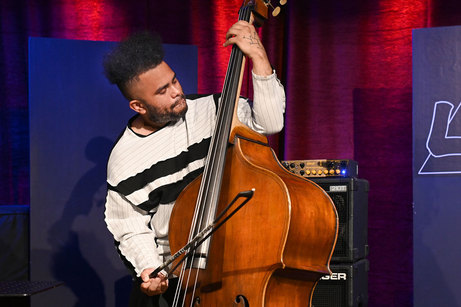
Nick Dunston with Ben Lamar Gay, Tomeka Reid, Julian Otis & Caroline Jesalva
Lampo Performance Series
Jun 06, 2026
(7pm)
Performance
RSVP required, limited capacity
Nick Dunston premieres Near of Kin, a new song cycle about family—chosen and inherited, contemporary and ancestral, loving and damaging. The title comes from novelist Octavia Butler, whose writing grapples with kinship and power.
With Julian Otis and Ben Lamar Gay on vocals, Gay also on cornet and electronics, and a string trio of Caroline Jesalva, Tomeka Reid, and Dunston.
Nick Dunston (b.1996, Washington, D.C.) is a composer, improviser, and sound artist active in the New York and Berlin experimental music scenes. His work spans large-ensemble composition, improvisation, and multimedia projects, often integrating electronics and live processing.
Dunston has received commissions from Wet Ink Ensemble, Bang on a Can, JACK Quartet, Gaudeamus Festival, A L’ARME Festival, Ekmeles, and others, and has collaborated as a performer with artists including Marc Ribot, Ches Smith, Vijay Iyer, Mary Halvorson, Tyshawn Sorey, Moor Mother, Darius Jones, Lucrecia Dalt, Joy Guidry, Son Lux, Craig Taborn, Dave Douglas, Allison Miller, Anna Webber, and Amirtha Kidambi. In 2019 he received a Van Lier Fellowship from Roulette, supporting the creation of the trans-media song cycle La Operación, the double bass quintet piece The Floor is Lava!, and his debut studio album Atlantic Extraction.
Recent recordings include Spider Season (2022) and the Afro-surrealist-anti-opera COLLA VOCE (Out Of Your Head Records, 2024). Dunston can also be heard on the score to the film Everything Everywhere All at Once (2022). He has presented artist talks at institutions including the University of Southern California, California Institute of the Arts, the University of Iowa, and Stony Brook University. Dunston was nominated for the Deutscher Jazzpreis in 2023, 2024, and 2025, and with Cansu Tanrikulu won the SWR Jazz Prize in 2024.
Lampo, established in 1997, supports artists working in new music, experimental sound, and other interdisciplinary practices. The Chicago-based organization's core activity has been and remains its performance series. Rather than making programming decisions around tour schedules, Lampo invites selected artists to create and perform new work, and then the organization provides the space, resources, and curatorial support to help them fulfill their vision. Lampo also organizes artist talks, lectures, screenings, and workshops, and publishes written and recorded documents related to its series.
Accessibility: This event will be held in the ballroom on the third floor of the Madlener House, which is only accessible by stairs. The first-floor galleries and bookshop are accessible via outdoor lift. Please contact us at 312.787.4071 or info@grahamfoundation.org to make arrangements.
Note: Registration for Lampo programs is required, but does not guarantee entry. Capacity for this performance is limited. Doors open 30 minutes prior to the performance and seats are available on a first-come, first-serve basis for those registered in advance. Reservations expire 5 minutes before the performance start time, at which point seating will be released to the waitlist. Due to the popularity of the Lampo programs, performances quickly reach capacity. No late seating will be permitted.
Photo: G. Richter
Constructing Latin America: Architecture, Politics, and Race at the Museum of Modern Art
Patricio del Real
Jun 25, 2026
(6pm)
Talk
Free; RSVP required
Patricio del Real presents his book, Constructing Latin America. Architecture, Politics, and Race at the Museum of Modern Art (Yale University Press, 2022)—a nuanced look at how, through architecture exhibitions, this New York institution became a key agent in cultural politics in the United States and in the consolidation of “Latin American architecture” as a modernist category. Del Real demonstrates how The Museum of Modern Art (MoMA)’s curatorial activities generated and naturalized “Latin America” not only as a stylistic and cultural variant of international modernism but also as a racializing concept at a critical global conjuncture. The idea of “Latin American architecture” was seminal for the interpretation of modern architecture in the twentieth century and, moreover, for MoMA’s international projection as cultural arbiter in the Cold War period. It remains an active category that underpins studies on architectural modernism as a global phenomenon. Constructing Latin America was supported by a grant from the Graham Foundation in 2021. This talk is presented in conjunction with Latinitudes: A Collection of Latin American Modern Architecture by Leonardo Finotti, on view at the Graham Foundation through July 18, 2026.
Patricio del Real is known for his expertise in the field of architecture and architecture history, with a focus in the Americas. His work examines the intersections of buildings, politics and cultural identity. As an architectural historian, he contributes to a deeper understanding of the global dimensions of modernism, shedding light on its unique transformations and adaptations. One of his notable contributions is his focus on institutions and the transnational flows of ideas and practices and how these migrations have impacted both the development of architectural forms and the practices of architects in the second postwar period. Del Real is associate professor in the department of the history of art and architecture at Harvard University. Before his appointment at Harvard, he worked at The Museum of Modern Art’s architecture and design department on several temporary and collection exhibitions, and cocurated Latin America in Construction: Architecture 1955-1980.
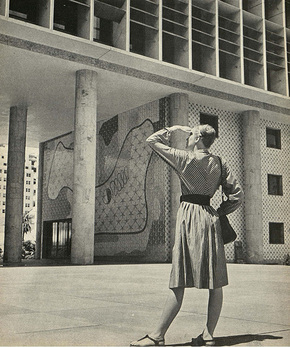
Image: Louise Dahl-Wolfe, Fashion shoot in front of the Ministério da Educação e Saúde (MES), Rio de Janeiro, Brazil, as published in, “Urban Cotton: For Being at Ease,” Harper’s Bazaar, May 1946
For more information on the exhibition, Latinitudes
A Collection of Latin American Modern Architecture, click here.
SHIFT: Architecture in Times of Radical Change
Chicago Architecture Biennial
Aug 29, 2026
(3pm)
Book Launch
Free; RSVP required
The Graham Foundation and the Chicago Architecture Biennial mark the release of SHIFT: Architecture in Times of Radical Change, published in conjunction with the sixth Chicago Architecture Biennial, led by artistic director Florencia Rodriguez.
SHIFT signals the opportunity and need to change direction—an invitation to think with others and to set new grounds for the interpretation and design of our built environments. Edited by Rodriguez, Santiago Bogani, Igo Kommers Wender, and Isabella Moretti, it is an editorial experiment on dispersion, embracing multiplicity as a method and conversation as a form. Featuring contributions from biennial participants and invited contributors, it acts as a curatorial capsule that extends SHIFT into print, opening new spaces for conversation, collective speculation, and architectural imagination.
Join Florencia Rodriguez and Igo Kommers Wender in conversation with biennial participants Kelly Bair (BairBalliet), Alexander Eisenschmidt, Clare Lyster (CLUAA), and Antonio Torres (The Bittertang Farm), followed by a reception. Copies of SHIFT, co-published by the Chicago Architecture Biennial and Park Books, will be available in the Graham Foundation bookshop.
Kelly Bair, co-founder of BairBalliet, leads a Chicago and Los Angeles practice whose speculative and built work spans architecture, exhibitions, and design research.
Alexander Eisenschmidt directs Studio Offshore, an architecture and urban design practice, and leads The Housing Futures Initiative, with work spanning design, writing, and international exhibitions.
Igo Kommers Wender, an architect, editor, and cultural producer based in Chicago, is associate curator of the 2025 Chicago Architecture Biennial.
Clare Lyster, founder of CLUAA, leads a research practice exploring how logistical and metabolic systems shape architecture, landscape, and infrastructure.
Florencia Rodriguez, founding principal of -NESS, leads an international cultural platform for architecture and served as Artistic Director of the 2025 Chicago Architecture Biennial.
Antonio Torres, co-founder of The Bittertang Farm, leads a playful, inventive design practice based in Chicago and Bainbridge Island whose work explores speculative forms and living materials.
ABOUT THE PUBLICATION
Essays, manifestos, and conversations feature: Kelly Bair; Arno Brandlhuber; Alejandra Celedón; Kate Yeh Chiu; Juan Du; Janet Echelman; Alexander Eisenschmidt; Valeria Esteves; Alison Fisher; Fredi Fischli; Giulia Foscari, UNA/UNLESS; Ignacio G. Galán; Amber Ginsburg; David Gissen; Architensions (Alessandro Orsini and Nick Roseboro); Jia Yi Gu; Akilah Halley; Chana Haouzi; Christopher Hawthorne; Rossana Hu; Daniel Ibáñez; Sam Jacob; Sharon Johnston; Wilfried Kuehn; Mark Lee; Clare Lyster, CLUAA; Simona Malvezzi; Florencia Medina; Caitlin Mueller; Cristiane Muniz; Janell Nelson; Niels Olsen; Tosin Oshinowo; Cristóbal Palma; David Peyceré; Hilary Sample; Gloria Sutton; Martien de Vletter.
The publication includes a five-hour conversation marathon on topics such as new realism, the magic in the ordinary, pleasures in the urban, and the need to critically shift architecture's language with Biennial participants Sebastián Adamo, Lilla Árkovics, Juan Manuel Balsa, Roberto Behar, Erin Besler, Caio Calafate, Sol Camacho, Abigail Chang, Lap Chi Kwong, Rocio Crosetto Brizzio, Attila Csóka, James Dallman, Iman Salam Fayyad, Nathalie Frankowski, Cruz Garcia, Adriana Giorgis, Alison von Glinow, Alejandro Haiek Coll, Grace La, Sean Lally, Frederico Leite, Lara Lesmes, Iván L. Munuera, Mireia Luzzárraga, Masa Mahlek, Maria Vittória Martins, Rosario Marquardt, Szabolcs Molnár, Noelia Monteiro, Daniel Moreno Flores, Frida Mouchlian, Leandro Piazzi, Lolo Rebecca Rudolph, Alejandro Saldarriaga, David Smiló, Alfredo Thiermann, Leonidas Trampoukis, Pedro Varella, Aura Venckunaite, Alex Yueyan Li, Ema Yuizarix, and Oscar Zamora.
Co-published by Chicago Architecture Biennial and Park Books
The Chicago Architecture Biennial convenes the world to explore innovative ideas and collectively imagine the future of design. The Biennial’s large-scale exhibitions, talks, performances, films, and other events, create opportunities to engage timely global issues through the lens of architecture and design, emphasizing creativity and community participation. Free and open to the public, the Chicago Architecture Biennial stands as North America’s largest international survey of contemporary architecture and design.
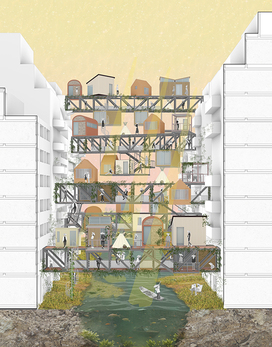
Image: Estudio Planta, Latin America Informal City 2025. Courtesy Estudio Planta
Exhibition Architecture: A conversation with Koray Duman
Independent Curators International (ICI)
Sep 14, 2026
(6pm)
Talk
Free; RSVP required
This conversation between architect Koray Duman and Graham Foundation director Sarah Herda will explore the role of exhibition architecture in shaping how artists, curators, and institutions communicate and engage with audiences. Using three aspects of Duman’s work—the curator, the institution, and the artist—as points of departure, they consider how exhibition design can become more than a framework for displaying art, but a tool for advancing curatorial and artistic visions and engaging audiences in new ways. Duman brings layers of storytelling, context, and meaning into projects spanning galleries, museums, biennials, and temporary public projects.
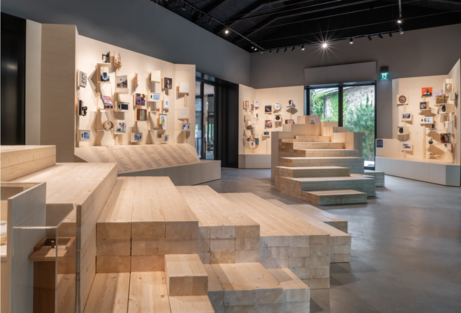
The conversation will begin with the curator, asking: how can exhibition design support and expand the curatorial statement? Duman introduces his work on the 59th Carnegie International and the display device developed for the Chimera installation at this year’s Venice Biennale, to illustrate how space and a cohesive design strategy can support multiple narratives as artists and curators increasingly tackle the complex cultural, social, and political issues of our time in their work. The Chimera installation, along with the Future Schools project, form the basis of their exploration of institutions. How can exhibition design create opportunities for community-building and engagement, and allow institutions to contend with limitations of space and resources while evolving and expanding their roles in society? Finally, they turn to the artist, using the example of Duman’s work with Paul Pfeiffer to consider how the architecture of an exhibition can actively contribute to an artist’s narrative, reveal complex dimensions of their practice, and deepen audiences’ engagement with the ideas they present.
Through frameworks of design in which visitors actively contribute to shared learning, exhibitions become more than sites of passive consumption. By treating them as temporary institutions—spaces capable of responding to temporary questions with greater flexibility than permanent architecture—Duman reveals exhibition-making as a rich tool for deepening connections among audiences, artworks, and the broader issues that artists and curators seek to address.
Presented in conjunction with Chicago Exhibition Week
Koray Duman is an architect and founder of Büro Koray Duman.
Büro Koray Duman (B-KD) is an award-winning, research-driven architecture and design studio based in New York City and Istanbul. Founded in 2013, the international practice approaches design as a tool for connection between people, designing stimulating, adaptable environments that nurture generosity, knowledge exchange, and evolving forms of community. Working across all typologies and scales, B-KD’s past clients include MoMA PS1, MOCA Geffen, Guggenheim Bilbao, the Finnish Cultural Institute NY, the Noguchi Museum, Istanbul Foundation for Culture and Arts, artist Richard Prince, the American Society for Muslim Advancement, and the Center for Art and Advocacy.
Independent Curators International (ICI) supports the work of curators to help create stronger art communities through experimentation, collaboration and international engagement. Curators are arts community leaders and organizers who champion artistic practice; build essential infrastructures and institutions; and generate public engagement with art. Our collaborative programs connect curators across generations, and across social, political and cultural borders. They form an international framework for sharing knowledge and resources — promoting cultural exchange, access to art and public awareness for the curator’s role.
Image: Denniston Hill, Chimera, 2026, installation view, 'In Minor Keys', 61st International Art Exhibition, La Biennale di Venezia. Design by Büro Koray Duman. Photo by Gaia Cambiaggi/Studio Campo. Courtesy of Denniston Hill.
Warp Duo
Lampo Performance Series
Sep 26, 2026
(7pm)
Performance
RSVP required, limited capacity
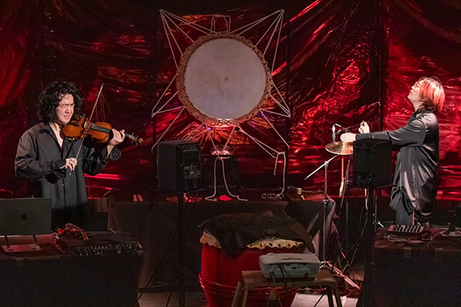
In Cradled Current, Warp Duo develops feedback as a shared instrumental language. Qiujiang Levi Lu and Scott Congyu Li perform on new systems that have emerged through their five-year collaboration, bringing their individual practices into closer contact.
Li uses a transducer-based system that feeds the amplified signal of their violin back through the body of the instrument. Bowing, plucking, muting, and physical contact with the violin alter the resulting sound, moving between resonant drones, unstable noise, and conventional string articulation. Lu performs with an intraoral speaker and feedback trombone routed through a joystick-controlled processing system. The processed signal returns through the speaker in Lu’s mouth, creating a recursive circuit between the body and electronic processing.
Warp Duo’s Cradled Current, created for Lampo, brings the two systems into a single environment—electrical and volatile, but also, as the title suggests, something held and carried between the two performers. The largely improvised work extends material from the duo’s earlier 沿光苍穹 / The Ever-Reaching, Luminescent Horizon.
Warp Duo is the queer Chinese American duo of Qiujiang Levi Lu and Scott Congyu Li. Using violin, trombone, voice, guitar, and live electronics, they combine free improvisation, electronic processing, and songs influenced by Chinese folk lullabies. Their work explores love, grief, fragility, intimacy, and human connection.
Scott Congyu Li (b. 1998, Princeton, N.J.) is a New York-based violinist, composer, producer, improviser, filmmaker, and electroacoustic sound artist. Their work combines string playing with modular synthesis, live processing, fixed media, film, photography, dance, and poetry.
Li has collaborated with musicians, filmmakers, visual artists, poets, and dancers, with projects ranging from pop production to experimental noise music. Their work has been presented by New World Symphony’s BLUE Project series, Miami; the University of Michigan Department of Dance, Ann Arbor, Mich.; and Pathos Trio. Performances include Park Avenue Armory, The Jazz Gallery, and Dripping, New York; Big Ears Festival, Knoxville, Tenn.; New World Center, Miami Beach, Fla.; REDCAT, Los Angeles; Rhizome DC, Washington, D.C.; A L’ARME! Festival, Berlin; and Cologne Jazzweek, Cologne, Germany, among others. Li is a recording engineer at the Juilliard School.
Qiujiang Levi Lu (b. 1999, Beijing) is an experimental musician, composer, creative technologist, and educator. They work across live performance, electroacoustic instrument design, installation, composition, film scoring, and multimedia collaboration. Lu builds electroacoustic instruments including intraoral microphone-speaker feedback systems, amplified laptop interfaces, and motion-sensing electronics. Their work brings Chinese musical lineages into conversation with noise, embodied technology, queerness, spirituality, and transformation.
Performances include La MaMa and MATA Festival, New York; Send + Receive, Winnipeg; High Zero Festival, Baltimore; IRCAM Forum, Paris; Threading Festival, Taipei; and Temple Dongjingyuan, Beijing, among others. Lu has been an artist-in-residence at Issue Project Room, Brooklyn; Harvestworks and The New School, New York; Wave Farm, Acra, N.Y.; and Elektronmusikstudion, Stockholm. They have received commissions from TAK Ensemble, Popebama, and Luke Helker, and support from the Foundation for Contemporary Arts Emergency Grants program, Ernst & Young Emergent Futures Fellowship, and NEW INC.
Lu is a lecturer in music at the University of Pennsylvania and Peabody Conservatory at Johns Hopkins University.
Lampo, established in 1997, supports artists working in new music, experimental sound, and other interdisciplinary practices. The Chicago-based organization's core activity has been and remains its performance series. Rather than making programming decisions around tour schedules, Lampo invites selected artists to create and perform new work, and then the organization provides the space, resources, and curatorial support to help them fulfill their vision. Lampo also organizes artist talks, lectures, screenings, and workshops, and publishes written and recorded documents related to its series.
Accessibility: This event will be held in the ballroom on the third floor of the Madlener House, which is only accessible by stairs. The first-floor galleries and bookshop are accessible via outdoor lift. Please contact us at 312.787.4071 or info@grahamfoundation.org to make arrangements.
Note: Registration for Lampo programs is required, but does not guarantee entry. Capacity for this performance is limited. Doors open 30 minutes prior to the performance and seats are available on a first-come, first-serve basis for those registered in advance. Reservations expire 5 minutes before the performance start time, at which point seating will be released to the waitlist. Due to the popularity of the Lampo programs, performances quickly reach capacity. No late seating will be permitted.
Photo: RoBotEaters
Josephine’s
Sharmyn Cruz Rivera and Daniel Giles
Oct 16, 2026
(6pm)
Talk
Free; RSVP required
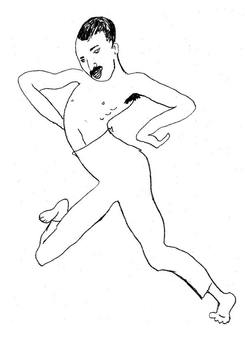
Daniel Giles and Sharmyn Cruz Rivera discuss Josephine’s, a multi-year research project on the Josephine Baker House (1927), its modernist architect Adolf Loos (1870–1933), and the iconic entertainer Josephine Baker (1906–1975), who served as inspiration for its design. Supported by a 2022 Graham Foundation research grant, the project has evolved from a close study of the house into an exploration of the cultural milieu in which it was conceived. Josephine’s draws on archival research at the Schomburg Center for Research in Black Culture at the New York Public Library, the Beinecke Library at Yale University, and the collection of the Albertina Museum, Vienna, along with site visits to the Paris location for which the house was designed; Baker’s Château des Milandes in southwestern France; and houses designed by Loos in Paris and Prague.
In this talk, Giles and Cruz Rivera consider the unbuilt Baker House, often regarded as an example of Loos’s modernist vision of architectural purity and his concept of the Raumplan, though less often discussed as an exercise in celebrity, as Loos leveraged Baker’s identity to raise his own profile. In their reading, the design concept for the house can ultimately be understood as a reflection of the workings of the modernist unconscious. Here, they contextualize their findings through a discussion of modernist ideologies, racial fantasy, and visibility, and also present Josephine’s: Prelude, a handmade artist book of images and writing reflecting on this research, produced to accompany an exhibition at terminal in Amsterdam earlier this year.
Daniel Giles is a Black American artist and educator based in Rotterdam, the Netherlands. His interdisciplinary artistic practice uses methods of appropriation and abstraction to question how power functions within representational systems. Giles’ work takes shape through studio practice as well as collaborative, research-based, and performative approaches, resulting in artworks, publications, and forms of pedagogy. Giles earned an MFA from Northwestern University and a BFA from the School of the Art Institute of Chicago. He is currently the Course Director of the Piet Zwart Institute Master of Fine Art in Rotterdam.
Sharmyn Cruz Rivera is a Puerto Rican curator and writer based in Rotterdam, the Netherlands. Her curatorial practice seeks to expand the boundaries of exhibition-making to make way for emerging formats of interdisciplinary collaboration, presentation, and dialogue. Cruz Rivera holds an MA in arts administration and policy from the School of the Art Institute of Chicago and a dual BA in art history and modern languages from the University of Puerto Rico. She currently serves as Coordinator of Theory of Art, Design and Culture at Willem de Kooning Academy in Rotterdam.
Image: Daniel Giles, Untitled (Le Tumulte Blanc), 2026. Courtesy the artist
David Behrman & Cleek Schrey
Lampo Performance Series
Nov 07, 2026
(7pm)
Performance
Free; RSVP required—coming soon
Electronic music pioneer David Behrman returns to Lampo after 14 years to perform with Cleek Schrey on hardanger d’amore. Together they present “Pushback against Tough Situations,” a program built around the interplay of acoustic performance and computer-controlled systems.
David Behrman (b.1937, Salzburg, Austria) has been active as a composer and artist since the 1960s and has created many works for performance as well as sound installations. Most of his music has involved homemade electronics and responsive systems that interact with collaborating performers. In 1966 he founded the Sonic Arts Union with Robert Ashley, Alvin Lucier, and Gordon Mumma. Working at Columbia Records in the late ’60s, he produced the Music of Our Time series of new music recordings, which presented works by Cage, Oliveros, Lucier, Reich, Riley, Pousseur, and other influential composers. He has had a long association with the Merce Cunningham Dance Company as composer and performer and has created music for several of the Company’s repertory pieces. He received a D.A.A.D. fellowship in 1988–89 and an Individuals Grant from the Foundation for Contemporary Arts in 1994. Behrman lives in New York.
Cleek Schrey (b.1984, Bath Co., Va.) is a fiddler, composer, and improviser. He plays traditional music from Appalachia and Ireland as well as experimental music with a wide range of musicians. Schrey performs on the hardanger d’amore, a violin with sympathetic strings, and the daxophone, a wooden idiophone designed by Hans Reichel. His practice is preoccupied with the physical phenomena of vibrating strings and the histories and aesthetics of recording technologies. Collaborators include composer David Behrman, the viol da gamba player Liam Byrne, traditional fiddle icon Caoimhín Ó Raghallaigh, and the late Fluxus artist Yasunao Tone. He has performed at the Big Ears Festival, Knoxville, Tenn.; Kilkenny Arts Festival, Kilkenny; SuperSense Festival of the Ecstatic, Melbourne; Issue Project Room, Brooklyn; Roulette, Brooklyn (in a program curated by Meredith Monk); and the Beckett in London Festival with Gare St. Lazare, London, among others. Recent releases include The Southern Harmony and Musical Companion (Pagans, 2024), a recording of shape-note melodies transcribed for organs with Weston Olencki, and Beehive Cathedral (Dear Life Records, 2024), an album of traditional southern music with Joseph Decosimo and Luke Richardson. Past residencies include Pioneer Works, Brooklyn; Roulette, Brooklyn; Harvestworks, New York; and the Watermill Center, Water Mill, N.Y. Schrey holds an MFA in Music Composition from Princeton University and has lectured at the University of Pennsylvania and the Cooper Union. He lives in Brooklyn.
Lampo, established in 1997, supports artists working in new music, experimental sound, and other interdisciplinary practices. The Chicago-based organization's core activity has been and remains its performance series. Rather than making programming decisions around tour schedules, Lampo invites selected artists to create and perform new work, and then the organization provides the space, resources, and curatorial support to help them fulfill their vision. Lampo also organizes artist talks, lectures, screenings, and workshops, and publishes written and recorded documents related to its series.
Accessibility: This event will be held in the ballroom on the third floor of the Madlener House, which is only accessible by stairs. The first-floor galleries and bookshop are accessible via outdoor lift. Please contact us at 312.787.4071 or info@grahamfoundation.org to make arrangements.
Note: Registration for Lampo programs is required, but does not guarantee entry. Capacity for this performance is limited. Doors open 30 minutes prior to the performance and seats are available on a first-come, first-serve basis for those registered in advance. Reservations expire 5 minutes before the performance start time, at which point seating will be released to the waitlist. Due to the popularity of the Lampo programs, performances quickly reach capacity. No late seating will be permitted.
FORCE! an opera in three acts
Anna Martine Whitehead
Nov 12, 2026
(6pm)
Book Launch
Free; RSVP required
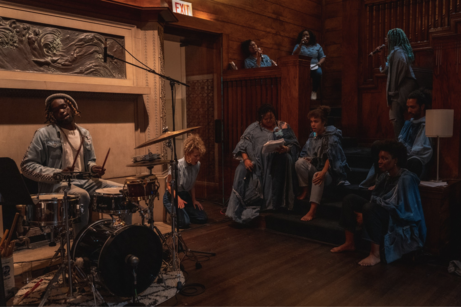
Simply defined as a "big work," an opera is a song cycle capacious enough to contain multitudes. Anna Martine Whitehead's FORCE! an opera in three acts is a big work of strange sisterhoods, featuring fractaline characters with the power to disintegrate walls. A meditation on often-overlooked spaces—prison waiting rooms—FORCE! travels through silence, sound, and rhythm to dissipate borders between performers and audience members. The work is a black femme story of interior lives and shared fantasies, busy with what blooms in the shadows of the bureaucratic state and of carceral power.
In December 2019, the Graham Foundation opened its doors to a "jam session" with Anna Martine Whitehead, which doubled as an undercover audition for FORCE! an opera in three acts. Whitehead returned to the Madlener House as a 2020 Graham Foundation Fellow to develop the work, much of the opera's first two years unfolding on-site. From there grew a 4.5-year endeavor of writing, choreographing, scoring, and building an opera.
Now published by Sming Sming Books following the opera's 2024 tour, FORCE! brings together a foreword by Re'al Christian with the libretto and its footnotes, contributions by Suchi Branfman, Jenn Freeman, Maria Gaspar, and David Thomson, and a live recording of the opera. Using the prison as a particular prism through which we can bear witness to the ways carceral systems replicate themselves, FORCE!, its notes, and the attendant collection of responses mark an attempt to abolish the Prison Industrial Complex in our heads, hearts, and houses.
To mark the launch, Whitehead shares highlights from the opera and its footnotes, alongside performances by Teiana Davis, Kai Black, Carmani Edwards, Daniella Hope, Nexus J, Zachary Nicol, and Eva Supreme. Publication contributor Maria Gaspar presents her ongoing project Disappearance Jail, a collective recording of the eventual erasure of carceral geographies in each of the 50 states within the U.S.
Copies of FORCE! an opera in three acts will be available for purchase from the Graham Foundation Bookshop.
Presented in conjunction with the Chicago Art Book Fair
Anna Martine Whitehead does performance from the homelands of the Council of the Three Fires (Chicago / Zhigaagong). Their solo and collaborative work has been presented by the Chicago Museum of Contemporary Art; REDCAT; Portland Institute for Contemporary Art; Chicago Symphony Orchestra; Museum of Modern Art; San José Museum of Art; The Chocolate Factory Theater; and Yerba Buena Center for the Arts. Anna Martine and her work have been recognized by Ruth Arts, United States Artists, the New England Foundation for the Arts, National Performance Network, the Graham Foundation, Vera List Center for Art and Politics, MAP Fund, Dance/USA, and the Foundation for Contemporary Arts. They have contributed chapters to a wide range of publications including In the Horizontal Plane: taisha paggett performance works (Soberscove, forthcoming); Queer Dance: Meanings and Makings (Oxford, 2017), and Platforms: Ten Years of Chances Dances (2016). Anna Martine is the author of FORCE! an opera in three acts (Sming Sming, 2026) and TREASURE | My Black Rupture (Thread Makes Blanket, 2016).
Anaiet is a pianist, guitarist, singer-songwriter and composer from the South Side of Chicago whose sound is a skillful blend of jazz, gospel, neo-soul, RnB, rock, and folk influences. Their music is a vulnerable testament to their lived experience, and is an experiment in somatic empathy and self-compassion, as they seek to inspire exploration and contemplation within the inner worlds of their audience.
Kai Black is a multi-instrumentalist, educator and solo recording artist from St. Louis, MO. They moved to Chicago to attend Columbia College, where he majored in Musical Instrumental Performance. Since then, he's been making waves in the Chicago underground/punk/jazz/queer scene collaborating and co-producing with a wide range of artists in Chicago. He's currently co-producing his debut solo project with Slam Lord Studios.
Carmani Edwards is an artist, bassist, and composer from the South Side of Chicago. Black Music has nourished their love of anything that grooves, and collective music making has become a cornerstone of their life. Keeping with these traditions, their songs are sketches, prayers, letters to loved ones, pages in their diary. They aim to show up to any collaboration grounded in care for fellow artists and listeners alike.
Maria Gaspar is a Chicago-born, first-generation, interdisciplinary artist negotiating the politics of location through installation, sculpture, sound, and performance. Gaspar's body of work addresses issues of spatial justice in order to amplify, mobilize, or divert structures of power through individual and collective gestures. Formative works like "Radioactive: Stories from Beyond the Wall" and the "96 Acres Project" include site interventions at the largest single-site jail in the country, the Cook County Department of Corrections, in her childhood neighborhood. She is Professor at the School of the Art Institute of Chicago.
Daniella Hope is a multifaceted artist who uses her siren sound and essence to evoke emotional density with graceful dexterity across various mediums. As the inaugural recipient of the BM in Jazz Voice from Oberlin Conservatory, her story is one of a trailblazer. She is currently crafting her debut album with plans for an artist residency preceding the album release.
Nexus J. is the Rap-Soul-Rock Stardust sending waves through Chicago. They're a vocal powerhouse with visceral lyricism bending and blending genre, movement, and storytelling toward art that sticks to your soul. It's Nina Simone meets Megan Thee Stallion meets Freddie Mercury meets Poet Laureate and yes, it's just as iconic as it sounds. Plug into Nexus J. and you connect to a heart hellbent on collective healing—a lighthouse in our journey toward worlds where we thrive.
Zachary Nicol is an artist and performer based in Chicago, working across dance, improvisation, writing, video, and sound. Nicol has contributed to dance, film, and performance projects by artists including Anna Martine Whitehead, Derek Spencer, AJ McClenon, Davide Balula, Erin Kilmurray, Andy Nicholas Li, Gabriel Chalfin-Piney-González, Adam Linder, Joe Namy, Mlondi Zondi, Alexandra Pirici, Ginger Krebs, and Catherine Sullivan, among others.
Image: Ricardo Adame
Henry Fraser
Lampo Performance Series
Dec 05, 2026
(7pm)
Performance
Free; RSVP required—coming soon
Henry Fraser performs Orexis, a new arrangement of his ongoing solo work, made for Lampo. Grounded in the physical properties of the double bass—its resonances, tactility, and size—Fraser explores the relationship between player and instrument. He attends to the bass’s smallest sounds: the sympathetic vibration of a string against a fingernail, the texture of fingers passing over a string, or beating patterns that emerge between tones.
He also draws on sources as disparate as Black American music, spectralism, Deep Listening, Gaelic psalm singing, and harsh noise, and finds among them a kind of coherence. Crucially, though, Fraser doesn’t turn the work into a succession of styles or techniques. In Orexis, the musical ideas may vary, but his way of treating them remains consistent.
Combining planned material and improvisation, Fraser “collaborates with the bass,” as he puts it, while inviting the audience to listen their way into the music alongside him.
Henry Fraser (b.1991, Boston, Mass.) is a New York-based double bassist, improviser, and composer. Collaborators include Ka Baird, Cleek Schrey, John Zorn, Uniform, Mary Halvorson, Randall Dunn, and Joey Arias. Performances include Carnegie Hall and Lincoln Center, New York; Roulette, Brooklyn; National Concert Hall of Ireland, Dublin; Moers Festival, Moers, Germany; Unlimited Festival, Wels, Austria; and Unsound Festival, Kraków. Since 2019, Fraser has concentrated on solo music for the double bass. His fourth solo album, Pneuma, was released by Kou Records in June 2026. Fraser was an Art Omi Music Fellow in 2021 and a NYSCA/NYFA Artist Fellow finalist in Music/Sound in 2022. In 2023, he joined Carnegie Hall’s Future Music Project as a teaching artist, leading music workshops with incarcerated youth in New York City. He held residencies at Pioneer Works and The Stone in 2025.
Lampo, established in 1997, supports artists working in new music, experimental sound, and other interdisciplinary practices. The Chicago-based organization's core activity has been and remains its performance series. Rather than making programming decisions around tour schedules, Lampo invites selected artists to create and perform new work, and then the organization provides the space, resources, and curatorial support to help them fulfill their vision. Lampo also organizes artist talks, lectures, screenings, and workshops, and publishes written and recorded documents related to its series.
Accessibility: This event will be held in the ballroom on the third floor of the Madlener House, which is only accessible by stairs. The first-floor galleries and bookshop are accessible via outdoor lift. Please contact us at 312.787.4071 or info@grahamfoundation.org to make arrangements.
Note: Registration for Lampo programs is required, but does not guarantee entry. Capacity for this performance is limited. Doors open 30 minutes prior to the performance and seats are available on a first-come, first-serve basis for those registered in advance. Reservations expire 5 minutes before the performance start time, at which point seating will be released to the waitlist. Due to the popularity of the Lampo programs, performances quickly reach capacity. No late seating will be permitted.
Unless otherwise noted,
all events take place at:
Madlener House4 West Burton Place, Chicago
GALLERY AND BOOKSHOP HOURS
Wednesday–Saturday, 12–5 p.m.
Free admission, no reservations required
CONTACT
312.787.4071
info@grahamfoundation.org
Accessibility
Events are held in the ballroom on the third floor which is only accessible by stairs.The first floor of the Madlener House is accessible via an outdoor lift. Please call 312.787.4071 to make arrangements.
Copyright © 2008–2026 Graham Foundation. All rights reserved.