David Behrman & Cleek Schrey
Lampo Performance Series
Nov 07, 2026
(7pm)
Performance
Free; RSVP required—coming soon
Electronic music pioneer David Behrman returns to Lampo after 14 years to perform with Cleek Schrey on hardanger d’amore. Together they present “Pushback against Tough Situations,” a program built around the interplay of acoustic performance with responsive computer-controlled music systems.
Behrman and Schrey perform Useful Information (2004), incorporating legal advice broadcast during the Republican National Convention in New York; Beyond ViewFinder (2026), a new work for bowed saw and interactive electronics; Recorders (2018), exploring electronic delay; and Runthrough (1967–2016), using computer-generated sound and flashlights to move sound around the performance space.
David Behrman (b.1937, Salzburg, Austria) has been active as a composer and artist since the 1960s and has created many works for performance as well as sound installations. Most of his music has involved homemade electronics and responsive systems that interact with collaborating performers.
In 1966, he founded the Sonic Arts Union with Robert Ashley, Alvin Lucier, and Gordon Mumma. Working at Columbia Records in the late ’60s, he produced the Music of Our Time series of new music recordings, which presented works by Cage, Oliveros, Lucier, Reich, Riley, Pousseur, and other influential composers. He has had a long association with the Merce Cunningham Dance Company as composer and performer and has created music for several of the Company’s repertory pieces. He received a D.A.A.D. fellowship in 1988–89 and an Individuals Grant from the Foundation for Contemporary Arts in 1994. Behrman lives in New York.
This is David Behrman’s fourth performance for Lampo: he performed in October 2012 with Okkyung Lee, in November 2006 with Mark Trayle, and in September 2003 with cellist Fred Lonberg-Holm. At the ’03 concert, which was his first Chicago performance since 1975, Behrman presented Homemade Synthesizer Music with Sliding Pitches and a new version of QS/RL made for Lonberg-Holm.
Cleek Schrey (b.1984, Bath Co., Va.) is a fiddler, composer, and improviser. He plays traditional music from Appalachia and Ireland as well as experimental music with a wide range of musicians. Schrey performs on the hardanger d’amore, a violin with sympathetic strings, and the daxophone, a wooden idiophone designed by Hans Reichel. His practice is preoccupied with the physical phenomena of vibrating strings and the histories and aesthetics of recording technologies.
Collaborators include composer David Behrman, the viol da gamba player Liam Byrne, traditional fiddle icon Caoimhín Ó Raghallaigh, and the late Fluxus artist Yasunao Tone. He has performed at the Big Ears Festival, Knoxville, Tenn.; Kilkenny Arts Festival, Kilkenny; SuperSense Festival of the Ecstatic, Melbourne; Issue Project Room, Brooklyn; Roulette, Brooklyn (in a program curated by Meredith Monk); and the Beckett in London Festival with Gare St. Lazare, London, among others.
Recent releases include The Southern Harmony and Musical Companion (Pagans, 2024), a recording of shape-note melodies transcribed for organs with Weston Olencki, and Beehive Cathedral (Dear Life Records, 2024), an album of traditional southern music with Joseph Decosimo and Luke Richardson.
Past residencies include Pioneer Works, Brooklyn; Roulette, Brooklyn; Harvestworks, New York; and the Watermill Center, Water Mill, N.Y. Schrey holds an MFA in Music Composition from Princeton University and has lectured at the University of Pennsylvania and the Cooper Union. He lives in Brooklyn.
In October 2025, Cleek Schrey premiered Strange Creek Music, a new fiddle work on his hardanger d’amore, designed for and performed in the 10 x 20-foot Lampo office. Across eight 20-minute performances for audiences of four, Schrey reimagined Appalachian fiddle tunes, moving from their traditional forms into free improvisation.

FORCE! an opera in three acts
Anna Martine Whitehead
Nov 12, 2026
(6pm)
Book Launch
Free; RSVP required
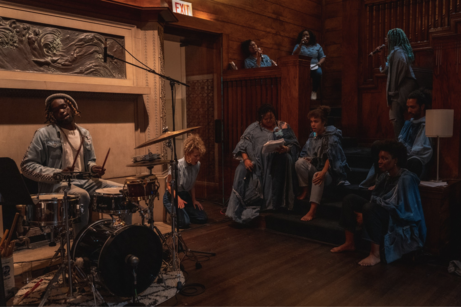
Simply defined as a "big work," an opera is a song cycle capacious enough to contain multitudes. Anna Martine Whitehead's FORCE! an opera in three acts is a big work of strange sisterhoods, featuring fractaline characters with the power to disintegrate walls. A meditation on often-overlooked spaces—prison waiting rooms—FORCE! travels through silence, sound, and rhythm to dissipate borders between performers and audience members. The work is a black femme story of interior lives and shared fantasies, busy with what blooms in the shadows of the bureaucratic state and of carceral power.
In December 2019, the Graham Foundation opened its doors to a "jam session" with Anna Martine Whitehead, which doubled as an undercover audition for FORCE! an opera in three acts. Whitehead returned to the Madlener House as a 2020 Graham Foundation Fellow to develop the work, much of the opera's first two years unfolding on-site. From there grew a 4.5-year endeavor of writing, choreographing, scoring, and building an opera.
Now published by Sming Sming Books following the opera's 2024 tour, FORCE! brings together a foreword by Re'al Christian with the libretto and its footnotes, contributions by Suchi Branfman, Jenn Freeman, Maria Gaspar, and David Thomson, and a live recording of the opera. Using the prison as a particular prism through which we can bear witness to the ways carceral systems replicate themselves, FORCE!, its notes, and the attendant collection of responses mark an attempt to abolish the Prison Industrial Complex in our heads, hearts, and houses.
To mark the launch, Whitehead shares highlights from the opera and its footnotes, alongside performances by Teiana Davis, Kai Black, Carmani Edwards, Daniella Hope, Nexus J, Zachary Nicol, and Eva Supreme. Publication contributor Maria Gaspar presents her ongoing project Disappearance Jail, a collective recording of the eventual erasure of carceral geographies in each of the 50 states within the U.S.
Copies of FORCE! an opera in three acts will be available for purchase from the Graham Foundation Bookshop.
Presented in conjunction with the Chicago Art Book Fair
Anna Martine Whitehead does performance from the homelands of the Council of the Three Fires (Chicago / Zhigaagong). Their solo and collaborative work has been presented by the Chicago Museum of Contemporary Art; REDCAT; Portland Institute for Contemporary Art; Chicago Symphony Orchestra; Museum of Modern Art; San José Museum of Art; The Chocolate Factory Theater; and Yerba Buena Center for the Arts. Anna Martine and her work have been recognized by Ruth Arts, United States Artists, the New England Foundation for the Arts, National Performance Network, the Graham Foundation, Vera List Center for Art and Politics, MAP Fund, Dance/USA, and the Foundation for Contemporary Arts. They have contributed chapters to a wide range of publications including In the Horizontal Plane: taisha paggett performance works (Soberscove, forthcoming); Queer Dance: Meanings and Makings (Oxford, 2017), and Platforms: Ten Years of Chances Dances (2016). Anna Martine is the author of FORCE! an opera in three acts (Sming Sming, 2026) and TREASURE | My Black Rupture (Thread Makes Blanket, 2016).
Anaiet is a pianist, guitarist, singer-songwriter and composer from the South Side of Chicago whose sound is a skillful blend of jazz, gospel, neo-soul, RnB, rock, and folk influences. Their music is a vulnerable testament to their lived experience, and is an experiment in somatic empathy and self-compassion, as they seek to inspire exploration and contemplation within the inner worlds of their audience.
Kai Black is a multi-instrumentalist, educator and solo recording artist from St. Louis, MO. They moved to Chicago to attend Columbia College, where he majored in Musical Instrumental Performance. Since then, he's been making waves in the Chicago underground/punk/jazz/queer scene collaborating and co-producing with a wide range of artists in Chicago. He's currently co-producing his debut solo project with Slam Lord Studios.
Carmani Edwards is an artist, bassist, and composer from the South Side of Chicago. Black Music has nourished their love of anything that grooves, and collective music making has become a cornerstone of their life. Keeping with these traditions, their songs are sketches, prayers, letters to loved ones, pages in their diary. They aim to show up to any collaboration grounded in care for fellow artists and listeners alike.
Maria Gaspar is a Chicago-born, first-generation, interdisciplinary artist negotiating the politics of location through installation, sculpture, sound, and performance. Gaspar's body of work addresses issues of spatial justice in order to amplify, mobilize, or divert structures of power through individual and collective gestures. Formative works like "Radioactive: Stories from Beyond the Wall" and the "96 Acres Project" include site interventions at the largest single-site jail in the country, the Cook County Department of Corrections, in her childhood neighborhood. She is Professor at the School of the Art Institute of Chicago.
Daniella Hope is a multifaceted artist who uses her siren sound and essence to evoke emotional density with graceful dexterity across various mediums. As the inaugural recipient of the BM in Jazz Voice from Oberlin Conservatory, her story is one of a trailblazer. She is currently crafting her debut album with plans for an artist residency preceding the album release.
Nexus J. is the Rap-Soul-Rock Stardust sending waves through Chicago. They're a vocal powerhouse with visceral lyricism bending and blending genre, movement, and storytelling toward art that sticks to your soul. It's Nina Simone meets Megan Thee Stallion meets Freddie Mercury meets Poet Laureate and yes, it's just as iconic as it sounds. Plug into Nexus J. and you connect to a heart hellbent on collective healing—a lighthouse in our journey toward worlds where we thrive.
Zachary Nicol is an artist and performer based in Chicago, working across dance, improvisation, writing, video, and sound. Nicol has contributed to dance, film, and performance projects by artists including Anna Martine Whitehead, Derek Spencer, AJ McClenon, Davide Balula, Erin Kilmurray, Andy Nicholas Li, Gabriel Chalfin-Piney-González, Adam Linder, Joe Namy, Mlondi Zondi, Alexandra Pirici, Ginger Krebs, and Catherine Sullivan, among others.
Image: Ricardo Adame
Henry Fraser
Lampo Performance Series
Dec 05, 2026
(7pm)
Performance
Free; RSVP required—coming soon
Henry Fraser performs Orexis, a new arrangement of his ongoing solo work, made for Lampo. Grounded in the physical properties of the double bass—its resonances, tactility, and size—Fraser explores the relationship between player and instrument. He attends to the bass’s smallest sounds: the sympathetic vibration of a string against a fingernail, the texture of fingers passing over a string, or beating patterns that emerge between tones.
He also draws on sources as disparate as Black American music, spectralism, Deep Listening, Gaelic psalm singing, and harsh noise, and finds among them a kind of coherence. Crucially, though, Fraser doesn’t turn the work into a succession of styles or techniques. In Orexis, the musical ideas may vary, but his way of treating them remains consistent.
Combining planned material and improvisation, Fraser “collaborates with the bass,” as he puts it, while inviting the audience to listen their way into the music alongside him.
Henry Fraser (b.1991, Boston, Mass.) is a New York-based double bassist, improviser, and composer. Collaborators include Ka Baird, Cleek Schrey, John Zorn, Uniform, Mary Halvorson, Randall Dunn, and Joey Arias. Performances include Carnegie Hall and Lincoln Center, New York; Roulette, Brooklyn; National Concert Hall of Ireland, Dublin; Moers Festival, Moers, Germany; Unlimited Festival, Wels, Austria; and Unsound Festival, Kraków. Since 2019, Fraser has concentrated on solo music for the double bass. His fourth solo album, Pneuma, was released by Kou Records in June 2026. Fraser was an Art Omi Music Fellow in 2021 and a NYSCA/NYFA Artist Fellow finalist in Music/Sound in 2022. In 2023, he joined Carnegie Hall’s Future Music Project as a teaching artist, leading music workshops with incarcerated youth in New York City. He held residencies at Pioneer Works and The Stone in 2025.
Lampo, established in 1997, supports artists working in new music, experimental sound, and other interdisciplinary practices. The Chicago-based organization's core activity has been and remains its performance series. Rather than making programming decisions around tour schedules, Lampo invites selected artists to create and perform new work, and then the organization provides the space, resources, and curatorial support to help them fulfill their vision. Lampo also organizes artist talks, lectures, screenings, and workshops, and publishes written and recorded documents related to its series.
Accessibility: This event will be held in the ballroom on the third floor of the Madlener House, which is only accessible by stairs. The first-floor galleries and bookshop are accessible via outdoor lift. Please contact us at 312.787.4071 or info@grahamfoundation.org to make arrangements.
Note: Registration for Lampo programs is required, but does not guarantee entry. Capacity for this performance is limited. Doors open 30 minutes prior to the performance and seats are available on a first-come, first-serve basis for those registered in advance. Reservations expire 5 minutes before the performance start time, at which point seating will be released to the waitlist. Due to the popularity of the Lampo programs, performances quickly reach capacity. No late seating will be permitted.
PAST EVENTS
Josephine’s
Sharmyn Cruz Rivera and Daniel Giles
Oct 16, 2026
(6pm)
Talk
Free; RSVP required
Daniel Giles and Sharmyn Cruz Rivera discuss Josephine’s, a multi-year research project on the Josephine Baker House (1927), its modernist architect Adolf Loos (1870–1933), and the iconic entertainer Josephine Baker (1906–1975), who served as inspiration for its design. Supported by a 2022 Graham Foundation research grant, the project has evolved from a close study of the house into an exploration of the cultural milieu in which it was conceived. Josephine’s draws on archival research at the Schomburg Center for Research in Black Culture at the New York Public Library, the Beinecke Library at Yale University, and the collection of the Albertina Museum, Vienna, along with site visits to the Paris location for which the house was designed; Baker’s Château des Milandes in southwestern France; and houses designed by Loos in Paris and Prague.
In this talk, Giles and Cruz Rivera consider the unbuilt Baker House, often regarded as an example of Loos’s modernist vision of architectural purity and his concept of the Raumplan, though less often discussed as an exercise in celebrity, as Loos leveraged Baker’s identity to raise his own profile. In their reading, the design concept for the house can ultimately be understood as a reflection of the workings of the modernist unconscious. Here, they contextualize their findings through a discussion of modernist ideologies, racial fantasy, and visibility, and also present Josephine’s: Prelude, a handmade artist book of images and writing reflecting on this research, produced to accompany an exhibition at terminal in Amsterdam earlier this year.
Daniel Giles is a Black American artist and educator based in Rotterdam, the Netherlands. His interdisciplinary artistic practice uses methods of appropriation and abstraction to question how power functions within representational systems. Giles’ work takes shape through studio practice as well as collaborative, research-based, and performative approaches, resulting in artworks, publications, and forms of pedagogy. Giles earned an MFA from Northwestern University and a BFA from the School of the Art Institute of Chicago. He is currently the Course Director of the Piet Zwart Institute Master of Fine Art in Rotterdam.
Sharmyn Cruz Rivera is a Puerto Rican curator and writer based in Rotterdam, the Netherlands. Her curatorial practice seeks to expand the boundaries of exhibition-making to make way for emerging formats of interdisciplinary collaboration, presentation, and dialogue. Cruz Rivera holds an MA in arts administration and policy from the School of the Art Institute of Chicago and a dual BA in art history and modern languages from the University of Puerto Rico. She currently serves as Coordinator of Theory of Art, Design and Culture at Willem de Kooning Academy in Rotterdam.
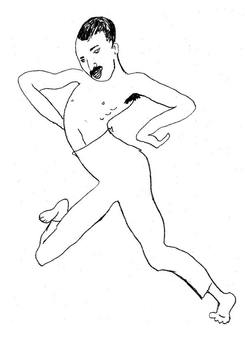
Image: Daniel Giles, Untitled (Le Tumulte Blanc), 2026. Courtesy the artist
Warp Duo
Lampo Performance Series
Sep 26, 2026
(7pm)
Performance
RSVP required, limited capacity
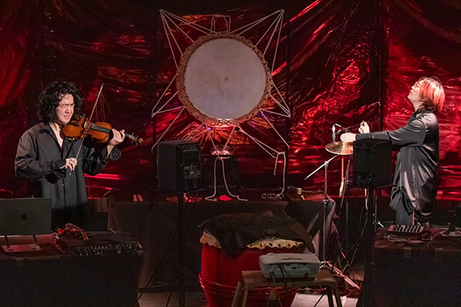
In Cradled Current, Warp Duo develops feedback as a shared instrumental language. Qiujiang Levi Lu and Scott Congyu Li perform on new systems that have emerged through their five-year collaboration, bringing their individual practices into closer contact.
Li uses a transducer-based system that feeds the amplified signal of their violin back through the body of the instrument. Bowing, plucking, muting, and physical contact with the violin alter the resulting sound, moving between resonant drones, unstable noise, and conventional string articulation. Lu performs with an intraoral speaker and feedback trombone routed through a joystick-controlled processing system. The processed signal returns through the speaker in Lu’s mouth, creating a recursive circuit between the body and electronic processing.
Warp Duo’s Cradled Current, created for Lampo, brings the two systems into a single environment—electrical and volatile, but also, as the title suggests, something held and carried between the two performers. The largely improvised work extends material from the duo’s earlier 沿光苍穹 / The Ever-Reaching, Luminescent Horizon.
Warp Duo is the queer Chinese American duo of Qiujiang Levi Lu and Scott Congyu Li. Using violin, trombone, voice, guitar, and live electronics, they combine free improvisation, electronic processing, and songs influenced by Chinese folk lullabies. Their work explores love, grief, fragility, intimacy, and human connection.
Scott Congyu Li (b. 1998, Princeton, N.J.) is a New York-based violinist, composer, producer, improviser, filmmaker, and electroacoustic sound artist. Their work combines string playing with modular synthesis, live processing, fixed media, film, photography, dance, and poetry.
Li has collaborated with musicians, filmmakers, visual artists, poets, and dancers, with projects ranging from pop production to experimental noise music. Their work has been presented by New World Symphony’s BLUE Project series, Miami; the University of Michigan Department of Dance, Ann Arbor, Mich.; and Pathos Trio. Performances include Park Avenue Armory, The Jazz Gallery, and Dripping, New York; Big Ears Festival, Knoxville, Tenn.; New World Center, Miami Beach, Fla.; REDCAT, Los Angeles; Rhizome DC, Washington, D.C.; A L’ARME! Festival, Berlin; and Cologne Jazzweek, Cologne, Germany, among others. Li is a recording engineer at the Juilliard School.
Qiujiang Levi Lu (b. 1999, Beijing) is an experimental musician, composer, creative technologist, and educator. They work across live performance, electroacoustic instrument design, installation, composition, film scoring, and multimedia collaboration. Lu builds electroacoustic instruments including intraoral microphone-speaker feedback systems, amplified laptop interfaces, and motion-sensing electronics. Their work brings Chinese musical lineages into conversation with noise, embodied technology, queerness, spirituality, and transformation.
Performances include La MaMa and MATA Festival, New York; Send + Receive, Winnipeg; High Zero Festival, Baltimore; IRCAM Forum, Paris; Threading Festival, Taipei; and Temple Dongjingyuan, Beijing, among others. Lu has been an artist-in-residence at Issue Project Room, Brooklyn; Harvestworks and The New School, New York; Wave Farm, Acra, N.Y.; and Elektronmusikstudion, Stockholm. They have received commissions from TAK Ensemble, Popebama, and Luke Helker, and support from the Foundation for Contemporary Arts Emergency Grants program, Ernst & Young Emergent Futures Fellowship, and NEW INC.
Lu is a lecturer in music at the University of Pennsylvania and Peabody Conservatory at Johns Hopkins University.
Lampo, established in 1997, supports artists working in new music, experimental sound, and other interdisciplinary practices. The Chicago-based organization's core activity has been and remains its performance series. Rather than making programming decisions around tour schedules, Lampo invites selected artists to create and perform new work, and then the organization provides the space, resources, and curatorial support to help them fulfill their vision. Lampo also organizes artist talks, lectures, screenings, and workshops, and publishes written and recorded documents related to its series.
Accessibility: This event will be held in the ballroom on the third floor of the Madlener House, which is only accessible by stairs. The first-floor galleries and bookshop are accessible via outdoor lift. Please contact us at 312.787.4071 or info@grahamfoundation.org to make arrangements.
Note: Registration for Lampo programs is required, but does not guarantee entry. Capacity for this performance is limited. Doors open 30 minutes prior to the performance and seats are available on a first-come, first-serve basis for those registered in advance. Reservations expire 5 minutes before the performance start time, at which point seating will be released to the waitlist. Due to the popularity of the Lampo programs, performances quickly reach capacity. No late seating will be permitted.
Photo: RoBotEaters

 PREVIOUS POSTS